
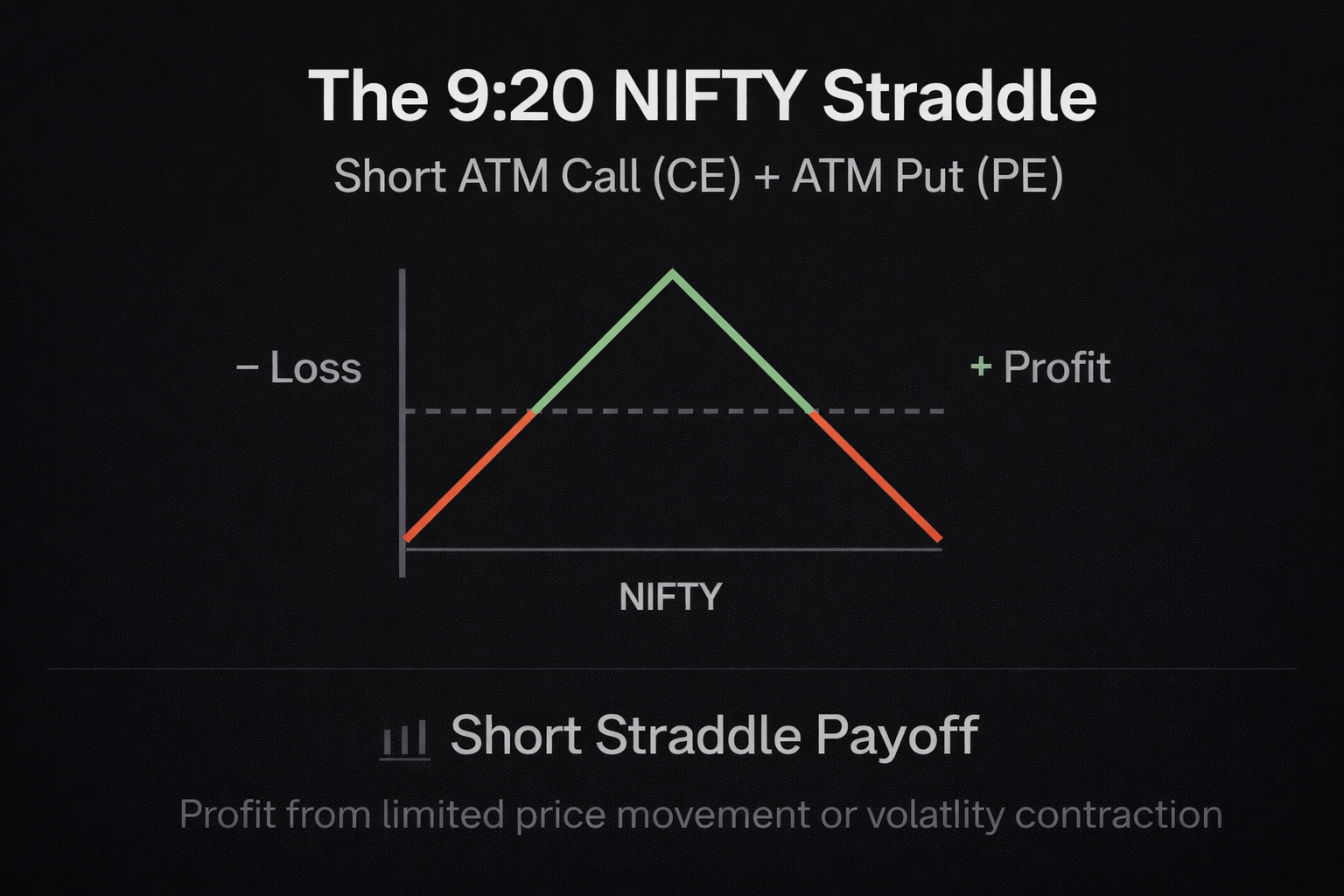
What Is the 9:20 Straddle?#
The 9:20 straddle is a popular intraday options strategy where traders:
- Short (sell) one ATM Call (CE) and one ATM Put (PE) on an index
- Enter the trade at 9:20 AM, slightly after market open
- Exit at a fixed time (e.g., 3:00 PM) or if a stop-loss is hit
The goal is to capture option premium decay if the market stays within a range.
Why Enter at 9:20 AM?#
Entering right at the open (9:15 AM) is often risky due to:
- High volatility
- Wide bid-ask spreads
- News-driven gaps
By 9:20 AM, spreads usually tighten, and the market starts to settle—leading to cleaner entries and fewer execution errors.
How the Short Straddle Works#
Basic trade setup:
- Time of Entry: 9:20 AM
- Action:
- Sell 1 lot of ATM CE
- Sell 1 lot of ATM PE
- Exit:
- Fixed time (e.g., 3:00 PM)
- Or if stop-loss hits on either leg (e.g., 25% per leg)
This is a short straddle, designed to profit from range-bound movement and time decay (theta).
Example (Generic)#
At 9:20 AM, the index is at 22,000:
- Sell ATM CE at ₹100
- Sell ATM PE at ₹105
- Total premium collected = ₹205
If both decay to ₹30 each by close:
- Net gain = (205 - 60) × lot size
Add stop-loss:
- SL hits if either leg rises 25% (e.g., ₹125–₹131.25)
When It Works Well#
- Market stays within a narrow range
- Implied volatility drops through the day
- No major news or economic data
- Slow, sideways price action
You keep the premium as both options lose value.
When It Fails#
- Trending or directional markets
- Sudden news or data surprises
- Volatile sessions (expiry, events, etc.)
The market moves strongly in one direction, and one leg spikes, leading to large losses unless stop-losses are enforced.
Common Strategy Add-ons#
- 25% stop-loss per leg
- Trail SL once MTM profit hits a level
- Exit early if profit meets target
- Hedge with far OTM options
- Re-entry logic after SL
These help manage risk and reduce extreme losses.
Backtesting the 9:20 Straddle#
Before going live, test with:
- Historical option data (CE/PE prices at 9:20 and throughout the day)
- Simulate entry/exit conditions
- Apply SLs and re-entries (if any)
- Metrics to analyze:
- Win/loss rate
- Maximum drawdown
- Average return per day
- Risk-reward consistency
Backtest across different environments: trend, expiry, news, low-IV days.
Automating the Strategy#
Because timing and SLs are critical, many traders automate this strategy.
Benefits of Automation:#
- Precise 9:20 AM entry
- Instant stop-loss execution
- Eliminate human emotion
- Enable re-entry or trailing logic
- Central logging for analysis
Using UAT environments like Nubra’s lets you:
- Test the strategy in live market conditions with virtual capital
- Safely simulate order logic
- Refine before going fully live
Pros and Cons#
| ✅ Pros | ⚠️ Cons |
|---|---|
| Simple and rules-based | Can suffer heavy losses on trends |
| Easy to backtest and simulate | Needs strict SL and risk controls |
| Can be automated fully | Sensitive to news/IV spikes |
| Works well in calm markets | Requires consistent discipline |
Final Takeaway#
The 9:20 straddle is one of the most used intraday options strategies in India—for good reason.
It’s structured, time-based, and rule-driven.
But it’s not without risk.
The real edge comes from how well you execute it:
- Follow SL rules
- Automate where possible
- Test with UAT or paper before going live
- Log every trade and review it
It's not just about timing the trade—it's about owning the process.
Watch the 9:20 Straddle in Action#