
A Practical Guide for Brokers, Fintechs, and Algo Traders
Algorithmic trading in India has entered a formal regulatory phase.
With the rollout of SEBI’s retail algo framework and exchange implementation standards, API-based trading is no longer just a technical integration — it is a regulated activity.
This guide distills the most operationally relevant rules around API trading, algo approvals, OPS limits, tagging, and broker responsibilities.
Algo Registration Process (High-Level Flow)#
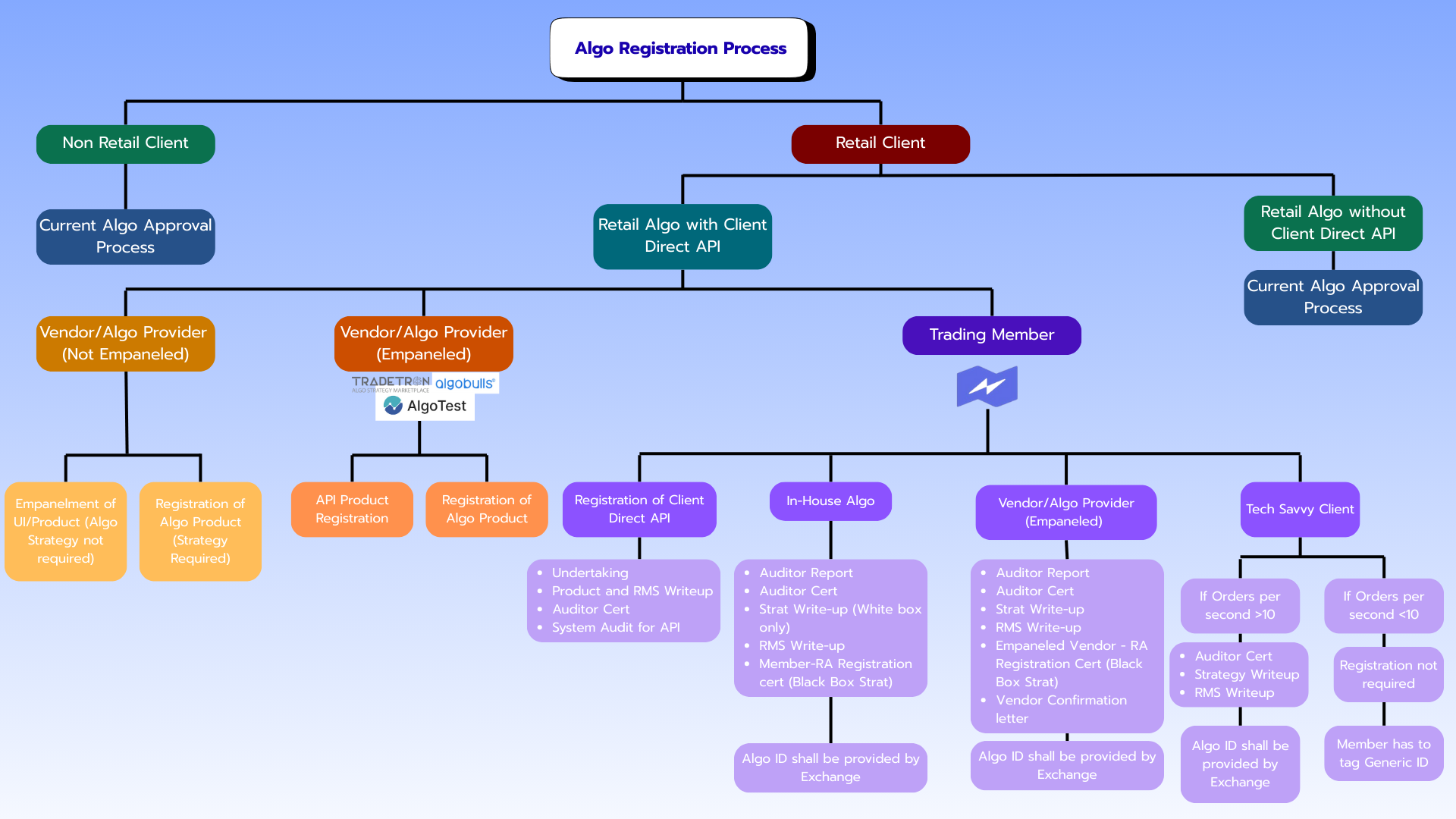
Key Idea
If a retail order is automated and sent via API, it is treated as an algorithmic order and must follow this framework.
Why SEBI Regulated API-Based Trading#
SEBI observed that:
- Retail traders increasingly used APIs and automation
- Algo activity occurred without uniform disclosure
- Risk controls varied significantly across brokers and platforms
To address this, SEBI mandated that:
All API orders are treated as algorithmic orders
Algo strategies must be classified, registered, and monitored
Brokers remain fully responsible for client orders
White Box vs Black Box Algos#
Retail algos are categorised as White Box or Black Box depending on whether the trading logic is disclosed and replicable.
🟦 White Box Algos#
Logic is disclosed and replicable
Examples
- TWAP
- VWAP
- Execution-only strategies
Mandatory Requirements
- Strategy write-up
- RMS explanation
- Auditor certificate
🟥 Black Box Algos#
Logic is not disclosed and not replicable
Examples
- Arbitrage strategies
- Alpha-seeking models
- High-frequency scalping
Additional Mandatory Requirements
- Research Analyst (RA) registration
- Detailed research report
- Any logic change → Fresh registration
Key Regulatory Takeaways (What Really Changed)#
Open APIs Are Effectively Banned#
Generic or shared API access is no longer permitted. All API calls must use unique client–vendor keys and whitelisted static IPs.
Brokers Are the Principal Party#
Regardless of who builds or hosts the algo, the broker owns full responsibility.
Mandatory Kill Switch#
Exchanges can unilaterally disable any Algo ID. Correct Algo ID tagging is mission critical.
Daily API Logout & 2FA#
API sessions must be logged out daily and re-authenticated with 2FA.
Static IP Rules Are Strict#
Each client must use a dedicated static IP. Shared office or VPS IPs are not allowed.
OPS ≤ 10 Is Not a Free Pass#
≤10 OPS applies only to tech-savvy retail clients. Orders remain algo orders and must be monitored.
Vendors Never Own Algo IDs#
Algo IDs are issued member-wise by the exchange. The broker remains the single point of control.
Who Is an Algo Provider (and How Retail Clients Differ)?#
An Algo Provider includes:
- Fintech vendors
- OMS / EMS providers
- Platforms offering automated trading or execution via APIs
⚠️ SEBI does not regulate algo providers directly
✅ Exchanges mandate empanelment
Only empanelled providers are allowed to work with brokers.
A Retail Client includes individuals using Client Direct APIs, including tech-savvy retail traders running their own automation.
- OPS ≤ 10 → Treated as algo orders but registration exempt (tech-savvy retail only; generic Algo ID required)
- OPS > 10 → Exchange registration mandatory with a unique Algo ID
All automated API orders remain algorithmic orders and are monitored by the broker.
How Nubra Can Help You Navigate SEBI Compliance#
As a SEBI-registered broker, Nubra directly enables compliant API-based and algorithmic trading for retail traders, algo providers, and fintech platforms under the retail algo framework.
Nubra acts as the single point of control for registration, execution, risk management, and exchange compliance.
Retail Traders (Including Tech-Savvy Retail)#
You should reach out to Nubra if:
- You are using APIs for automated trading
- You plan to run strategies close to or above OPS ≤ 10
- You need clarity on:
- Whether your strategy is White Box or Black Box
- When registration becomes mandatory
- How Algo ID tagging and generic Algo IDs work
- You want to avoid accidental violations such as:
- OPS breaches
- Static IP misuse
- Non-compliant API usage
How Nubra helps
- Assesses whether your strategy requires exchange registration
- Onboards you under the correct White Box / Black Box category
- Provides Client Direct API access with:
- OPS enforcement
- Static IP controls
- Mandatory Algo ID tagging
- Ensures your live execution complies with SEBI and exchange rules
Algo Providers / Fintech Platforms#
You should reach out to Nubra if:
- You provide algo strategies or execution platforms via APIs
- You need to:
- Get empanelled with the exchange
- Register algo products
- Operationalise strategies for Nubra clients
- You offer:
- Execution algos (TWAP / VWAP)
- Arbitrage, alpha, or high-frequency strategies
- You want to ensure:
- Correct White Box vs Black Box classification
- RA certification alignment (where required)
- No logic changes that trigger re-registration or penalties
How Nubra helps
- Works with empanelled algo providers under exchange guidelines
- Registers algo products and strategies as required
- Enforces logic versioning and mandatory re-registration on change
- Provides a compliant execution environment for Nubra clients
📞 Reach Out to Nubra#
You should reach out to Nubra if you are unsure whether:
- Your strategy requires exchange registration
- Your setup qualifies as White Box or Black Box
- You fall under the tech-savvy retail exemption
- Your current API usage is fully SEBI-compliant
Reach out to Nubra before going live.
Designing for compliance upfront is far easier than fixing violations later.
Important Clarification#
Nubra is the trading member (broker) under the SEBI retail algo framework.
All activities including:
- Client Direct API issuance
- Algo strategy registration
- Algo ID usage and tagging
- OPS monitoring, kill switches, and audits
are performed by Nubra as the broker, in accordance with SEBI and exchange regulations.
Nubra ensures that what gets registered runs compliantly in production.