When Infrastructure Fails, Traders Feel It First#
On volatile market days, traders expect uncertainty from price movement — not from the systems they rely on.
Yet during a recent Cloudflare service disruption, that expectation was broken.
Across regions, traders reported:
- Broker login pages not loading
- Dashboards freezing
- APIs returning timeouts
- Orders that could not be monitored
All of this happened while the stock exchanges themselves were still running normally.
The issue was not the market.
It was the infrastructure between traders and the market.
What Happened During the Cloudflare Event#
Cloudflare operates one of the largest traffic and security layers on the internet. It sits between users and applications, providing:
- Traffic routing
- DDoS protection
- Web security
- Content delivery
A large number of fintech platforms, brokers, and trading tools rely on Cloudflare as their first line of access.
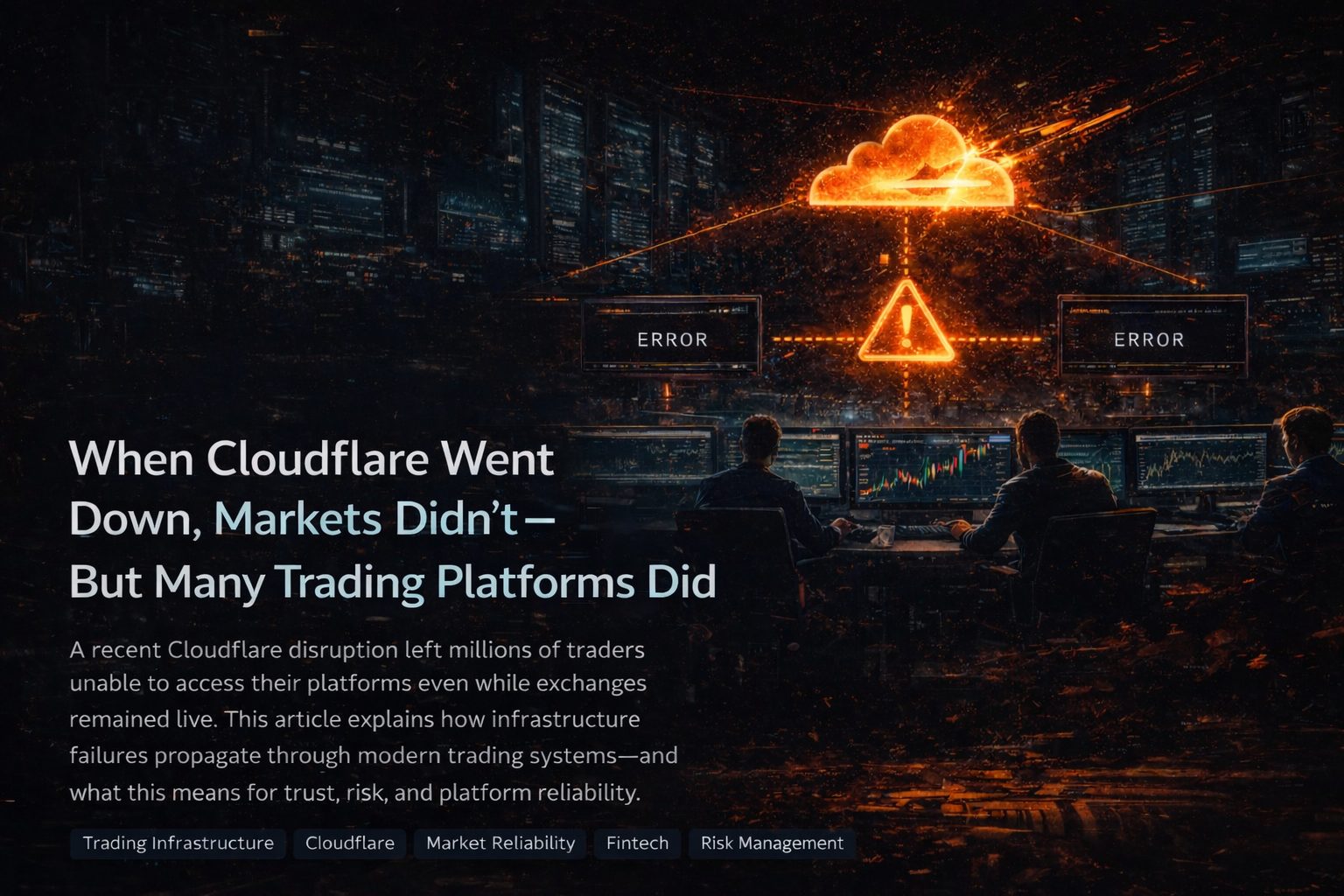
When Cloudflare experienced service degradation, many of these platforms became unreachable — even though their backend systems and the exchanges were still live.
This is why traders could not log in, even while prices continued to move.
How a Single Infrastructure Layer Affected Millions of Traders#
Most modern trading platforms follow this structure:
Trader → CDN / Security Layer → Broker Platform → Exchange
When the CDN and security layer fails:
- Broker UIs go dark
- Trading dashboards disappear
- APIs stop responding
- Risk visibility vanishes
For a trader, this means:
- You cannot see open positions
- You cannot hedge
- You cannot exit
- You cannot manage risk
Even a few minutes of lost access during volatility can result in forced exposure and financial loss.
In trading, availability is not convenience.
It is risk control.
Nubra Remained Live During the Outage#
During the Cloudflare disruption, Nubra publicly confirmed that its platform continued operating normally.
Official update:
https://x.com/nubra_io/status/1996883319225831577
“Even on the toughest days — when others slow down — Nubra is still ON, ticking.”
This update was issued while many platforms were experiencing access failures — providing real-time confirmation that traders on Nubra were not impacted by the Cloudflare event.
Why These Outages Damage More Than Uptime#
Traders don’t just trade with capital — they trade with confidence.
They can accept:
- A learning curve
- A missing feature
- A delayed UI update
But they don’t forget:
- Being locked out during volatility
- Not knowing whether their order executed
- Watching the market move while their screen is frozen
Infrastructure failures create trust failures.
Once that trust is shaken, traders begin re-evaluating where they trade.
The Structural Risk in Modern Trading Platforms#
The Cloudflare outage exposed something deeper than a temporary disruption.
It revealed how many platforms depend on the same centralized infrastructure layers.
This creates:
- Shared failure points
- Systemic downtime
- Simultaneous outages across competing brokers
In financial markets, where milliseconds matter,
infrastructure resilience becomes part of the trading system itself.
Final Takeaway#
Markets will always be volatile.
Platforms should not be.
The Cloudflare event showed how quickly millions of traders can lose access — not because exchanges failed, but because the path to those exchanges did.
When the next high-volatility day arrives, traders will remember which platforms stayed accessible — and which ones disappeared behind a loading screen.