
Iceberg orders are often explained as hiding size. That framing is both incomplete and dangerous.
Icebergs do not make you invisible. They make you less legible.
What an Iceberg Order Actually Is#
An Iceberg order splits a large parent order into smaller visible slices (legs).
Only the current slice is displayed; the rest stays hidden until needed.
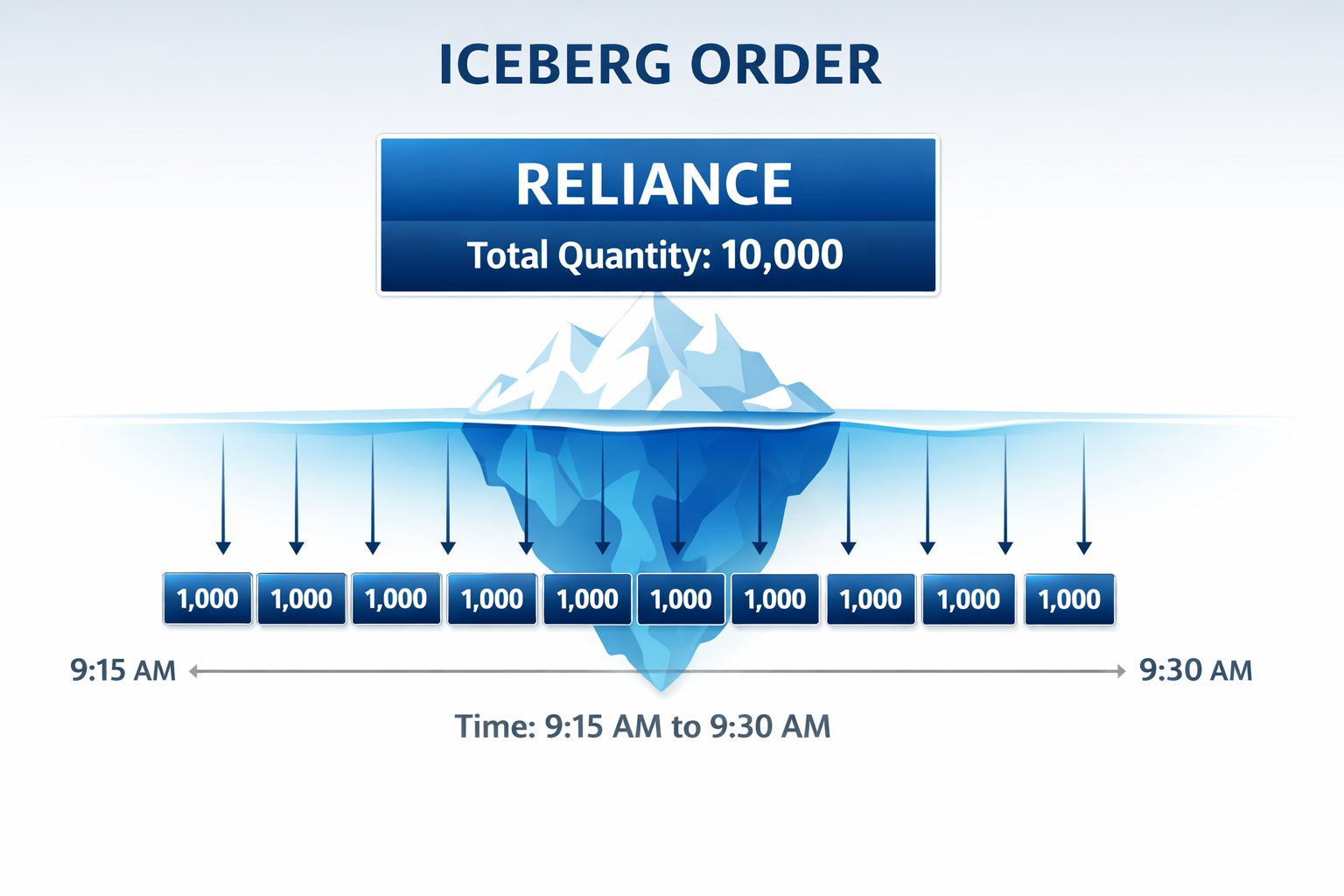
That's the mechanism. The purpose is to reduce signalling and manage impact.
Why Exchanges Support Iceberg Orders#
Exchanges are not doing you a favour. They are supporting market quality.
Icebergs help exchanges:
- Encourage large participation without destabilising the book
- Reduce the incentive to spray large visible orders
- Improve the chance that size can be executed in an orderly way
It is a market design tool, not a retail hack.
Who Benefits Most (and Why)#
Icebergs are most useful when visibility is costly.
- Institutions: need to move size without broadcasting intent
- Large directional traders: want fills without immediate adverse reaction
- Liquidity-sensitive participants: care more about impact than speed
Small traders can use icebergs too, but the edge is less about hiding and more about execution hygiene.
Icebergs and Price Discovery: A Necessary Tension#
Icebergs reduce visible information in the book. That can:
- Smooth some impact
- Also make the book look thinner than it truly is
This is not inherently good or bad. It is a trade-off between signalling and transparency.
Iceberg vs TWAP vs VWAP: Choose Based on Failure Modes#
A practical way to choose order types is to choose your preferred failure.
- Iceberg: risk of incomplete execution; lower signalling
- TWAP: risk of being gamed over time; predictable schedule
- VWAP: risk of volume model mismatch; volume-aware schedule
If you cannot tolerate incomplete fills, icebergs are not your primary tool.
Misconceptions That Cause Bad Trades#
Three bad assumptions show up repeatedly:
- Icebergs guarantee better prices. They do not.
- Hidden size means no impact. It still has impact.
- I can ignore leg size tuning. Leg size is the strategy.
A broker-grade iceberg API should force leg size clarity rather than guess it.