
Our realtime surface is powerful, and the integration mistakes are predictable: subscribing to everything, mixing symbol and ref_id streams, and ignoring weight budgets.
Here's how we recommend you wire it up so it stays stable under load.
One Connection, Multiple Streams#
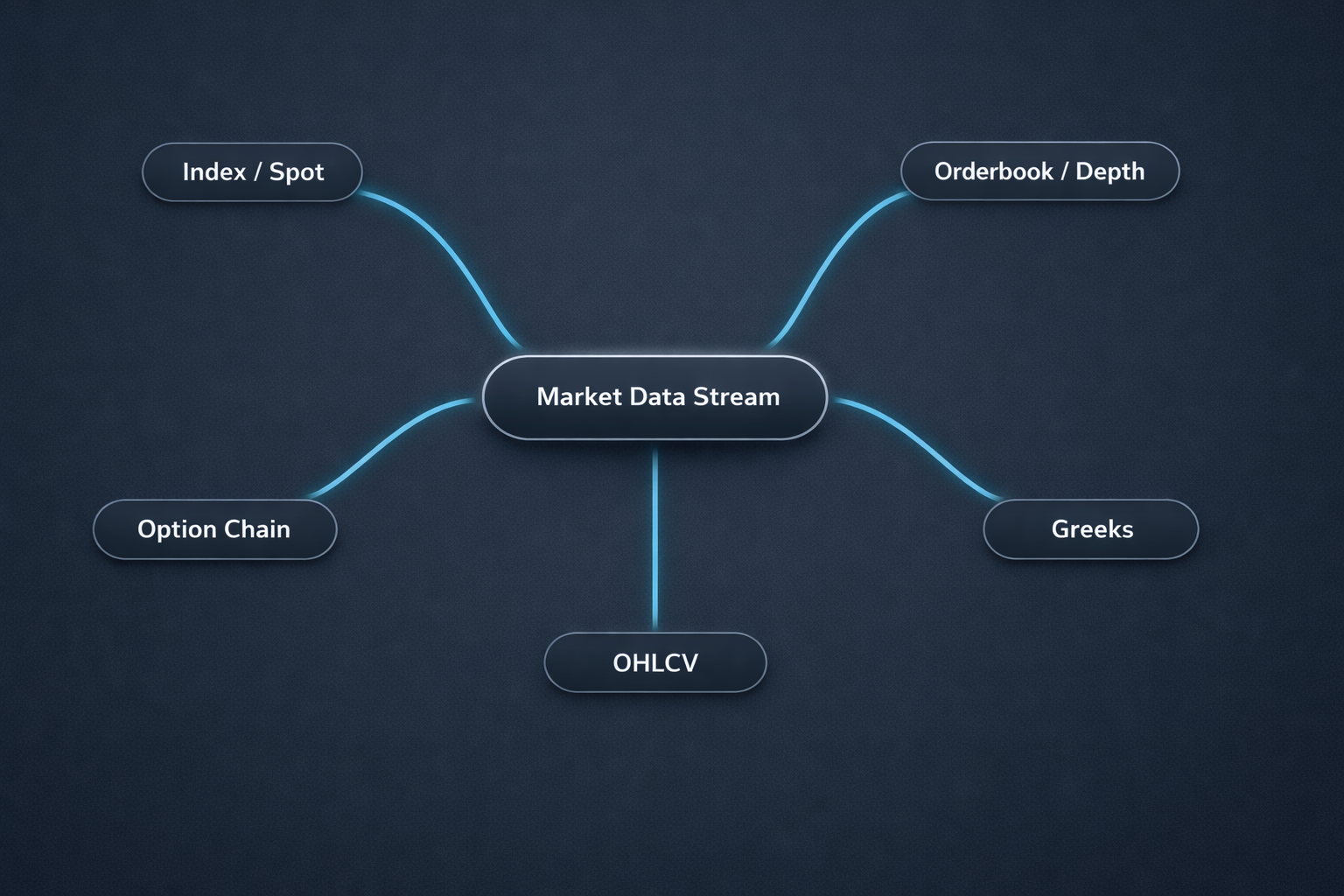
We provide a single WebSocket client (NubraDataSocket) that can subscribe to multiple stream types.
Stream categories include:
- Index data
- Option chain data
- Order book data
- Greeks data
- OHLCV data
A Working Connection Skeleton#
from nubra_python_sdk.ticker import websocketdata
from nubra_python_sdk.start_sdk import InitNubraSdk, NubraEnv

nubra = InitNubraSdk(NubraEnv.UAT)

def on_market_data(msg):
    print(f"[MarketData] {msg}")

def on_error(err):
    print(f"Error: {err}")

socket = websocketdata.NubraDataSocket(client=nubra, on_market_data=on_market_data, on_error=on_error)
socket.connect()
keep_running() will block the main thread. If you need to continue doing work in the same process, run the socket in a separate thread.
Subscription Semantics by Stream (Symbol vs ref_id)#
One of the most important details in our realtime design: some streams use symbols, others use reference IDs.
Index stream (symbols)#
socket.subscribe(["NIFTY", "HDFCBANK"], data_type="index", exchange="NSE")Index messages arrive on the index wrapper and include fields like indexname, exchange, timestamp, index_value, and changepercent.
Option chain stream (symbol:expiry)#
socket.subscribe(["RELIANCE:20250626"], data_type="option", exchange="NSE")Option chain updates include asset, expiry, at_the_money_strike, current_price, and lists of ce/pe option data.
Orderbook stream (ref_id)#
socket.subscribe(["1746686"], data_type="orderbook")Orderbook updates include ref_id, last_traded_price, and depth in bids and asks.
Greeks stream (ref_id)#
socket.subscribe(["1058227"], data_type="greeks", exchange="NSE")Greeks updates include iv, delta, gamma, theta, vega, and open-interest fields on the option data wrapper.
OHLCV stream (symbols + interval)#
socket.subscribe(["NIFTY", "HDFCBANK"], data_type="ohlcv", interval="10m", exchange="NSE")Supported intervals include: 1m, 2m, 3m, 5m, 10m, 15m, 30m, 1h, 2h, 4h, 1d, 1wk, 1mt.
Weight Budgets Are a Design Constraint#
We enforce weight-based WebSocket limits. Each active subscription consumes weight.
Weights per subscription:
- Option Chain: 20
- Order Book: 5
- OHLC: 2
- Index: 1
- Greeks: 1
Session limit (free tier): 20,000 points.
Weight math you should actually do#
Do the weight math before you subscribe. If you exceed the session weight, the subscription will be rejected.
Practical Realtime Patterns We Recommend#
- Run the socket in a separate thread when you need non-blocking behavior
- Use lifecycle callbacks (
on_connect,on_close,on_error) - Subscribe only to the streams you actively use
- Keep symbol-vs-
ref_idusage consistent per stream
A simple threading pattern:
import threading

def run_websocket():
    socket.connect()
    socket.subscribe(["NIFTY"], data_type="index")
    socket.keep_running()

threading.Thread(target=run_websocket, daemon=True).start()
A Safe Realtime Integration Checklist#
- Choose streams deliberately; don't subscribe by default
- Use symbols where required and
ref_idwhere required - Budget subscriptions using the weight table
- Use callbacks for lifecycle visibility and recovery
- Keep interval values inside the supported list