Implied volatility, or IV, is the market’s estimate of how much an underlying asset may move during the remaining life of an option. I do not read IV as a prediction that the price will go up or down. I read it as the option market’s expectation of movement size. That distinction matters. If a…
Implied volatility, or IV, is the market’s estimate of how much an underlying asset may move during the remaining life of an option. I do not read IV as a prediction that the price will go up or down. I read it as the option market’s expectation of movement size.
That distinction matters. If a Nifty option has high IV, the market is not necessarily saying Nifty will rise. It is saying traders are pricing in a wider possible move before expiry. The move can be upward, downward, or both at different points in the trade.
In options trading, IV is one of the main reasons two options with similar strikes and expiries can feel expensive or cheap. When IV rises, option premiums usually rise because the market is assigning more value to uncertainty. When IV falls, premiums usually become cheaper because the market is pricing in less movement.
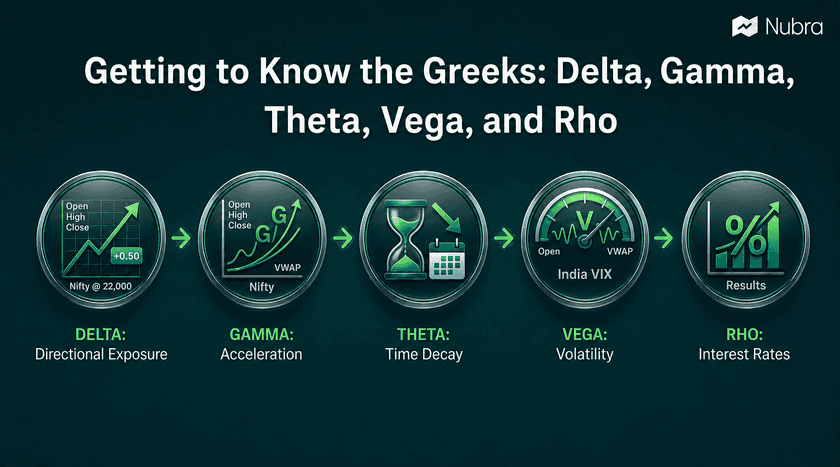
I like to think of IV as the price of uncertainty inside an option premium. Delta tells me how the option may react to the underlying price. Theta tells me how time decay may affect it. Vega tells me how the option may react if IV changes. IV is the input that makes vega important.
This article is for education only and should not be treated as investment advice. Options trading involves market risk, and examples are used only to explain how IV works.
How Implied Volatility Works Inside an Option Premium
An option premium is not just a simple bet on direction. It reflects several variables at once: the current underlying price, strike price, time to expiry, interest rates, dividends where relevant, and expected volatility. IV is the expected volatility part of that calculation.
In practice, IV is not directly observed like the Nifty level or a stock price. It is backed out from option prices. If traders are willing to pay higher premiums for the same strike and expiry, the option pricing model may imply a higher volatility number. If premiums cool off, implied volatility may fall.
This is why I avoid saying, “IV caused the option premium to rise” as if IV is always the first mover. In live markets, demand for options, event risk, hedging flows, and market uncertainty can push premiums up. IV is the volatility number implied by those premiums after the pricing model accounts for the other known inputs.
Here is a simplified way to read it:
| Market condition | What I usually see in IV | What I usually see in premiums |
|---|---|---|
| Calm market, limited event risk | Lower IV | Cheaper options |
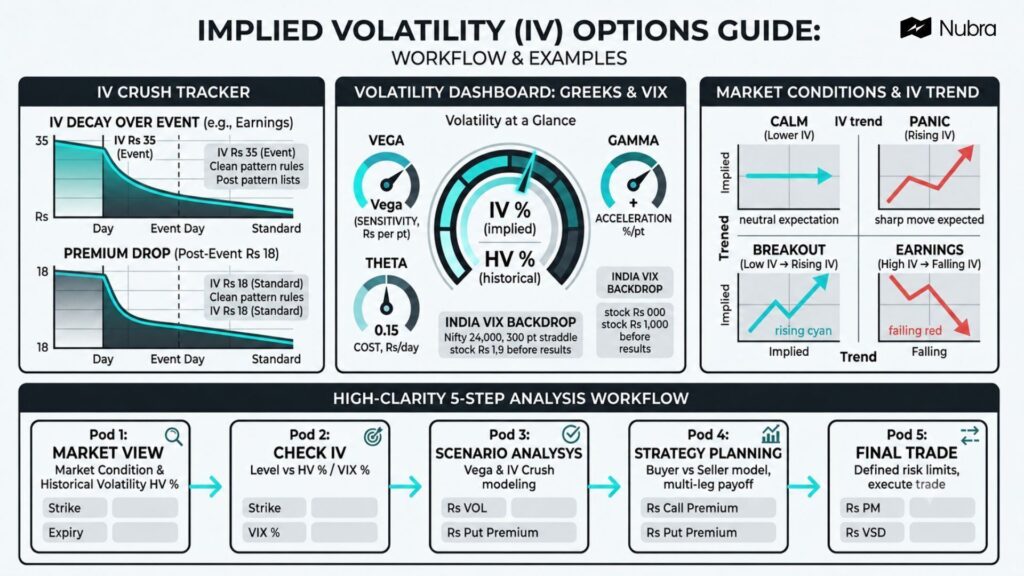
| Earnings, budget, policy decision, or expiry uncertainty | Higher IV | Costlier options |
| Event passes and uncertainty drops | Falling IV | Premiums can fall quickly |
| Panic or sharp sell-off | Rising IV | Put and call premiums may expand, especially puts |
The key point is that IV affects both calls and puts. If implied volatility rises, call premiums and put premiums can both increase, even if the underlying has not moved much. That is because volatility is about the expected size of movement, not the direction.
Implied Volatility vs Historical Volatility
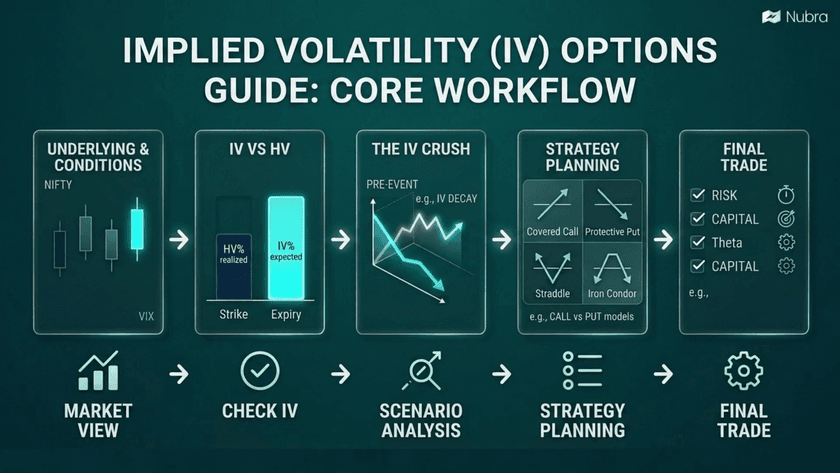
I separate implied volatility from historical volatility before making sense of any option chain.
Historical volatility looks backward. It tells me how much the underlying actually moved over a past period. For example, I may look at how much Nifty moved over the last 20 trading sessions.
Implied volatility looks forward. It tells me what the options market is pricing for the future, usually until the option expires.
| Factor | Historical volatility | Implied volatility |
|---|---|---|
| Time direction | Looks at past movement | Prices expected future movement |
| Source | Underlying price history | Current option premiums |
| Main use | Understand realised movement | Understand option pricing expectations |
| Can it change without a price move? | Not meaningfully in real time | Yes, if option demand or uncertainty changes |
| Useful question | “How much did this move?” | “How much movement is the market pricing now?” |
If IV is much higher than recent historical volatility, I ask why traders are paying extra for options. There may be an event ahead, a sharp market regime change, or aggressive hedging demand. If IV is lower than realised movement, I ask whether the market is underpricing risk or simply expecting conditions to calm down.
Neither reading gives a guaranteed trade. It only gives a better framework for understanding the premium.
Why IV Rises and Falls
IV usually rises when uncertainty rises. Before a major earnings announcement, RBI policy decision, Union Budget, election result, or global risk event, traders may buy options for protection or speculation. That demand can make premiums more expensive and push implied volatility higher.
IV usually falls when uncertainty reduces. After an event is over, the market may no longer need to price the same range of possible outcomes. This is where many option buyers experience what traders often call IV crush: the underlying may move in the expected direction, but the option premium can still fall if IV drops sharply after the event.
For example, suppose a stock is trading at ₹ 1,000 before results. A 1,020 call expiring later that month trades at ₹35 because the market expects a large result-day move. After results, the stock rises to ₹ 1,018, but the option falls to ₹ 18 because the uncertainty premium has disappeared and time decay has also worked against the buyer. The direction was almost right, but the premium still declined.
That is one of the first practical lessons I learned from IV: being right on direction is not always enough. In options, I also need to be aware of what I paid for volatility.
IV can also rise during market sell-offs. Index volatility often expands when traders rush to buy protection or when price moves become disorderly. In India, traders often watch India VIX for a broad read on expected volatility in Nifty options. NSE describes India VIX as a volatility index based on NIFTY option prices that indicates expected market volatility over the next 30 calendar days.
How I Read IV With India VIX, Option Chains, and Vega
When I look at IV, I do not use one number in isolation. I usually combine three views: the broad volatility index, the option chain, and vega.
India VIX gives me the broad index-level volatility backdrop. If India VIX is rising, I assume the market is pricing more uncertainty into Nifty options. If it is falling, I assume the broad market is pricing a calmer environment. This does not tell me whether Nifty will rise or fall. It only helps me understand how much movement the market is preparing for.
The option chain gives me strike-level detail. I check whether IV is unusually high around certain strikes, whether near-expiry options are pricing more movement than next-month options, and whether puts are carrying higher IV than calls. In index options, downside protection demand can make put IV look elevated.
Vega tells me how sensitive the option is to changes in IV. If an option has a vega of 4, a one percentage point increase in IV may add about ₹ 4 to the option premium, all else equal. A one percentage point drop in IV may reduce the premium by about ₹ 4, all else equal.
This “all else equal” condition is important because real option prices move with multiple Greeks at the same time. Delta, theta, gamma, and vega can all affect the premium between entry and exit.
Example 1: Nifty Weekly Option Before a Major Event
Suppose Nifty is at 24,000 and there is a major policy event before weekly expiry. The 24,000 call and 24,000 put both become expensive because traders expect a large move. The at-the-money straddle may trade at a combined premium of ₹ 300.
That ₹ 300 does not mean Nifty will definitely move 300 points. It means the option market is charging a premium that may require a meaningful move for long option buyers to overcome the combined effects of time decay and post-event IV decline.
If I am buying an option in that situation, I need to ask: am I paying for movement that has already been priced in? If I am selling premium, I need to ask the opposite question: am I being paid enough for the risk of a larger-than-expected move?
Neither side is automatically better. High IV can make option selling look attractive because premiums are larger, but the same high IV often exists because the market sees real risk. A short straddle or short strangle can face sharp losses if the underlying moves beyond the collected premium.
Example 2: Stock Option IV Before Earnings
Consider a stock trading at ₹ 800 before quarterly earnings. The 820 call trades at ₹ 28 with elevated IV. A trader buys the call because they expect strong results.
After earnings, the stock rises to ₹ 825, but IV drops because the event risk is gone. The option trades at ₹ 22. The buyer was directionally correct, but the trade still lost money because the premium paid before the event included a large volatility component.
This is why I compare the expected move with the premium. If the option is already pricing a large move, the underlying may need to move more than expected or move quickly enough before IV and theta reduce the premium.
Example 3: Low IV Before a Breakout
Low IV does not mean low risk. It means the market is pricing less expected movement. If a stock has been range-bound and options are cheap, IV may sit at a lower level. A trader may buy options expecting a breakout.
The attraction is clear: lower premium means the buyer is paying less volatility. But the risk is also clear: if the breakout does not happen soon, theta can still erode the option. Low IV can stay low for longer than expected.
This is why I do not treat low IV as an automatic buy signal. I use it as one input. I still need a view on timing, liquidity, strike selection, and the risk that the underlying remains quiet.
Example 4: High IV and a Short Straddle
Suppose Bank Nifty is at 52,000 and the at-the-money call and put together trade at ₹ 600 because IV is high. A short straddle seller collects ₹ 600 and expects the index to stay within a range.
The trade benefits if Bank Nifty remains range-bound and IV falls. But if Bank Nifty moves sharply after an event, the loss can expand quickly. High IV gives more premium, but it does not remove gap risk, execution risk, or the risk of a trend day.
When I evaluate this kind of setup, I focus on scenario analysis rather than the premium alone. I want to know what happens if the index moves 300, 600, or 1,000 points; what happens if IV rises further; and how quickly theta can realistically help.
How I Use IV Before Choosing an Options Strategy
Before I choose an options strategy, I use IV to understand what I am paying for or receiving. If I am buying options, I want to know whether the premium is inflated by event risk. If I am selling options, I want to know whether the premium compensates for the possible move.
I also compare IV across expiries. A near-week option may have high IV because of a specific event, while a monthly option may price a different volatility picture. That difference can affect calendars, diagonals, and other multi-leg strategies.
For multi-leg options, I prefer to look at the entire payoff instead of one leg’s IV. Nubra Strategy Builder can help a trader model how the position may react if the underlying moves, time passes, or IV changes. The output is still a scenario, not a guarantee.
Nubra Option Chain lets me inspect strike-level implied volatility and Greeks for the selected expiry. I can use Nubra Charts to review the underlying price action and Nubra Strategy Builder to compare options payoff scenarios. Reviewing these views together helps me assess the position beyond a single IV figure.
The aim is not to predict market movements with certainty, but to make potential risks more visible before a trade goes live.
What IV Does Not Tell Me
IV does not tell me direction. A high-IV option can be followed by an up move, down move, or no meaningful move after the event.
IV does not tell me whether the option is a good trade. An option can be expensive for a valid reason. It can also remain expensive while uncertainty persists.
IV does not replace risk management. Position sizing, liquidity, stop rules, margin impact, and exit planning still matter.
IV does not guarantee that realised volatility will match implied volatility. The market can overprice or underprice movement, and the difference becomes visible only after the fact.
I find IV most useful when I treat it as a question, not an answer: what movement is already priced into this option, and what has to happen for this trade to make sense?
FAQs
What does implied volatility mean in options?
Implied volatility is the market’s estimate of how much an underlying asset may move during the life of an option. It is derived from option premiums and is usually shown as an annualised percentage.
Does high IV mean the stock will fall?
No. High IV means the market is pricing a larger possible move, not a specific direction. The underlying can rise, fall, or remain range-bound after IV rises.
Why do option premiums rise when IV rises?
Option premiums rise with IV because a larger expected move increases the probability that an option may become valuable before expiry. Both calls and puts can become more expensive when IV expands.
What is IV crush?
IV crush is a sharp fall in implied volatility, often after a major event such as earnings or policy news. It can reduce option premiums even when the underlying moves in the expected direction.
How is IV different from India VIX?
IV can refer to the implied volatility of a specific option contract. India VIX is a broader index based on NIFTY option prices and reflects expected market volatility over the next 30 calendar days.
Is low IV better for option buyers?
Low IV can make options cheaper, which may help buyers avoid paying inflated premiums. But low IV does not guarantee a profitable trade. The underlying still needs to move enough and soon enough to offset time decay and other risks.
Is high IV better for option sellers?
High IV can create higher premiums for option sellers, but it often comes with higher event risk or market uncertainty. Selling options during high IV can still be risky if the underlying moves sharply.
Can IV be used alone to select a strategy?
No. IV should be combined with price view, time to expiry, liquidity, Greeks, margin impact, and scenario analysis. It is an important input, not a complete trading system.
Disclaimer: The information provided in this blog is for educational and informational purposes only and should not be construed as investment advice, financial advice, or a recommendation to buy, sell, or hold any securities or financial products. Investments in the securities market are subject to market risks. Please read all related documents carefully before investing. Readers should conduct their own research and consult a SEBI-registered investment adviser or other qualified financial professional before making any investment decisions. Past performance is not indicative of future results.