
The Opening Range Breakout (ORB) is one of the most widely followed intraday trading strategies used by discretionary and algorithmic traders alike.
Its strength lies in simplicity, structure, and discipline — no complex indicators, no predictions, just price reacting to early market momentum.
This blog explains the ORB strategy conceptually and visually, to help traders understand how it works.
What Is the Opening Range?#
The opening range is defined as the price movement during the first few minutes after market open.
In this strategy:
- Market opens at 9:15 AM (IST)
- The first 5-minute candle (9:15–9:20) defines the range
- The high and low of this candle become key decision levels
This initial window often captures:
- Overnight sentiment
- Institutional positioning
- Early momentum for the day
ORB Strategy Overview#
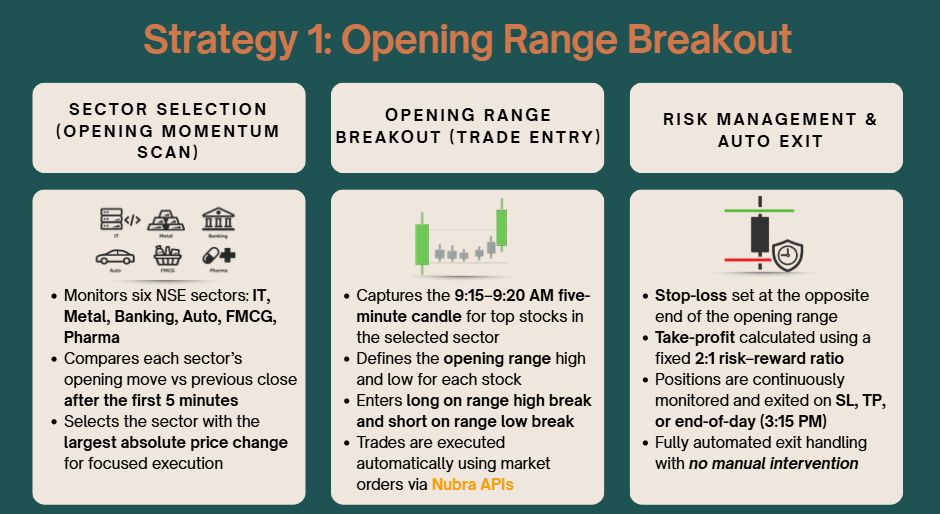
The ORB strategy follows a structured flow:
1. Sector Selection (Opening Momentum Scan)#
- Monitors multiple NSE sectors such as:
- IT
- Banking
- Metal
- Auto
- FMCG
- Pharma
- Measures which sector shows the strongest early move
- Focuses trading only on stocks within the strongest sector
This keeps execution aligned with where momentum already exists.
2. Opening Range Definition#
- Captures the first 5-minute candle
- Marks:
- Opening Range High
- Opening Range Low
- These two levels act as breakout boundaries for the day
No indicators, no averages — just raw price levels.
3. Trade Entry Logic#
- Long Trade
- Triggered when price breaks above the opening range high
- Short Trade
- Triggered when price breaks below the opening range low
Trades are:
- Directional
- Momentum-based
- Taken only when price confirms intent
4. Risk Management & Exit Rules#
Risk control is built into the structure:
- Stop-loss
- Placed at the opposite end of the opening range
- Take-profit
- Calculated using a fixed 2:1 risk–reward ratio
- Exit Conditions
- Stop-loss hit
- Target hit
- End-of-day square-off (3:15 PM)
This ensures defined risk on every trade.
Automated Order Placement (Example)#
Below is an example of how the ORB strategy places and manages trades automatically using Nubra APIs.
🎥 ORB Strategy — Order Placement Demo
Why Traders Like ORB#
- Clear, rule-based entries
- No subjective interpretation
- Defined risk before entering a trade
- Works well in trending or volatile markets
- Easy to automate and backtest
ORB is especially popular among traders who prefer discipline over discretion.
Important Disclaimer#
⚠️ Educational Use Only
This strategy is shared strictly for learning and educational purposes.
- It is not financial advice
- It is not a recommendation to trade
- It is not intended to be deployed live without extensive testing, risk assessment, and compliance checks
Markets involve risk, and trading strategies can result in losses. Always do your own research and consult a qualified professional before trading real capital.
Example code for the above#
from time import sleep
from datetime import datetime
import pytz

from nubra_python_sdk.start_sdk import InitNubraSdk, NubraEnv
from nubra_python_sdk.marketdata.market_data import MarketData
from nubra_python_sdk.trading.trading_data import NubraTrader
from nubra_python_sdk.refdata.instruments import InstrumentData

# =========================================================
# SDK INITIALIZATION
# =========================================================
nubra = InitNubraSdk(NubraEnv.UAT, env_creds=True)
md = MarketData(nubra)
trade = NubraTrader(nubra, version="V2")
instruments = InstrumentData(nubra)

IST = pytz.timezone("Asia/Kolkata")

# =========================================================
# STRATEGY CONFIG
# =========================================================
ALLOW_NEW_ENTRIES = True
MANAGE_POSITIONS = True
RR = 2.0
QTY = 1

# =========================================================
# STATE
# =========================================================
positions = {}
orb_levels = {}
last_bar_key = None

# =========================================================
# TIME GATE — EXACT 5 MIN FROM 09:15 IST
# =========================================================
def is_5min_gate():
    now = datetime.now(IST)

    if now.hour < 9 or (now.hour == 9 and now.minute < 15):
        return False

    minutes_from_open = (now.hour * 60 + now.minute) - (9 * 60 + 15)
    return minutes_from_open % 5 == 0 and now.second < 2


def get_bar_key():
    return datetime.now(IST).strftime("%Y-%m-%d %H:%M")

# =========================================================
# UTILITIES
# =========================================================
def get_ltp(symbol):
    try:
        return md.current_price(symbol).price
    except Exception:
        return None


def get_ref_id(symbol):
    return instruments.get_instrument_by_symbol(
        symbol, exchange="NSE"
    ).ref_id


def place_order(symbol, side):
    trade.create_order({
        "ref_id": get_ref_id(symbol),
        "order_side": "ORDER_SIDE_BUY" if side == "BUY" else "ORDER_SIDE_SELL",
        "order_type": "ORDER_TYPE_REGULAR",
        "price_type": "MARKET",
        "order_qty": QTY,
        "validity_type": "IOC",
        "order_delivery_type": "ORDER_DELIVERY_TYPE_IDAY",
        "exchange": "NSE",
        "tag": "ORB_5MIN"
    })

# =========================================================
# ORB LOGIC
# =========================================================
def capture_orb(symbol):
    data = md.historical_data({
        "exchange": "NSE",
        "type": "STOCK",
        "values": [symbol],
        "fields": ["high", "low"],
        "interval": "5m",
        "intraDay": True,
        "realTime": False
    })

    candle = data.result[0].values[0][symbol].high[0]

    orb_levels[symbol] = {
        "high": candle.value,
        "low": data.result[0].values[0][symbol].low[0].value
    }

    print(f"📊 ORB {symbol} | H={orb_levels[symbol]['high']} L={orb_levels[symbol]['low']}")

# =========================================================
# POSITION MANAGEMENT
# =========================================================
def manage_position(symbol, pos):
    ltp = get_ltp(symbol)
    if ltp is None:
        return

    if pos["side"] == "BUY":
        if ltp <= pos["sl"] or ltp >= pos["tp"]:
            place_order(symbol, "SELL")
            positions.pop(symbol)
            print(f"❌ EXIT {symbol}")

    else:
        if ltp >= pos["sl"] or ltp <= pos["tp"]:
            place_order(symbol, "BUY")
            positions.pop(symbol)
            print(f"❌ EXIT {symbol}")

# =========================================================
# MAIN LOOP
# =========================================================
print("🚀 ORB STRATEGY STARTED (CLOCK-ALIGNED)")
print("⏱ 5-MIN EXECUTION FROM 09:15 IST\n")

while True:
    try:
        if is_5min_gate():
            bar_key = get_bar_key()

            if bar_key != last_bar_key:
                last_bar_key = bar_key
                print(f"\n⏱ New 5-min candle @ {bar_key}")

                # Capture ORB once
                if not orb_levels:
                    for symbol in ["INFY", "TCS", "WIPRO"]:
                        capture_orb(symbol)
                    continue

                # Breakout logic
                for symbol, levels in orb_levels.items():
                    if symbol in positions:
                        continue

                    ltp = get_ltp(symbol)
                    if ltp is None:
                        continue

                    if ltp > levels["high"]:
                        sl = levels["low"]
                        tp = ltp + RR * (ltp - sl)
                        place_order(symbol, "BUY")
                        positions[symbol] = {
                            "side": "BUY",
                            "sl": sl,
                            "tp": tp
                        }
                        print(f"✅ LONG {symbol} @ {ltp}")

                    elif ltp < levels["low"]:
                        sl = levels["high"]
                        tp = ltp - RR * (sl - ltp)
                        place_order(symbol, "SELL")
                        positions[symbol] = {
                            "side": "SELL",
                            "sl": sl,
                            "tp": tp
                        }
                        print(f"✅ SHORT {symbol} @ {ltp}")

                # Manage open positions
                for symbol, pos in list(positions.items()):
                    manage_position(symbol, pos)

        sleep(1)

    except Exception as e:
        print(f"🔥 STRATEGY ERROR: {e}")
        sleep(2)
Final Thoughts#
The Opening Range Breakout strategy is a reminder that simplicity often outperforms complexity.
By focusing on:
- Early market behavior
- Clean price levels
- Structured risk management
ORB offers a solid framework for understanding intraday momentum-based trading.
Whether used for learning, backtesting, or conceptual clarity, ORB remains one of the most intuitive ways to study how markets behave at the open.