
We designed our auth flow as a staged process. If you treat it like a single login call, you'll end up with brittle automation.
We'll focus on what helps you run safely in production: clear token roles, strict header hygiene, and consistent x-device-id usage.

The Token Ladder (Temp ? Auth ? Session)#
You will see three different tokens in our auth flow:
temp_token: returned bysendphoneotpauth_token: returned byverifyphoneotpsession_token: returned byverifypin
Use this mental model:
temp_tokenmeansOTP has been initiatedauth_tokenmeansOTP has been verifiedsession_tokenmeansthe session is authenticated
Most protected endpoints should be called with a valid Bearer session_token.
Step-by-Step: OTP ? MPIN (The Core Flow)#
1) Initiate OTP#
curl --location 'https://api.nubra.io/sendphoneotp' \
--header 'Content-Type: application/json' \
--data '{
  "phone": "0000000000",
  "skip_totp": false
}'
The response includes a temp_token and a next step of VERIFY_MOBILE.
2) Verify OTP with x-temp-token and x-device-id#
OTP verification is also where we bind the device context.
curl --location 'https://api.nubra.io/verifyphoneotp' \
--header 'x-temp-token: eyJh...zd0' \
--header 'x-device-id: TS123' \
--header 'Content-Type: application/json' \
--data '{
  "phone": "0000000000",
  "otp": "341874"
}'
The response includes an auth_token and a next step of ENTER_MPIN.
3) Verify MPIN using Authorization: Bearer <auth_token>#
This is the step that produces the session token you'll use everywhere else.
curl --location 'https://api.nubra.io/verifypin' \
--header 'x-device-id: TS123' \
--header 'Content-Type: application/json' \
--header 'Authorization: Bearer 7a1171e6-...' \
--data '{
  "pin": "1234"
}'
The response includes a session_token and a next step of DASHBOARD.
Optional TOTP Flow (Layered on Top of a Session)#
We support TOTP as a secondary method you can enable after you already have a valid session token.
A reliable way to think about it:
- Session first
- TOTP configuration second
- TOTP login becomes an alternative entry path
Generate the secret#
curl --location 'https://api.nubra.io/totp/generate-secret' \
--header 'Authorization: Bearer {{session_token}}' \
--header 'x-device-id: {{device_id}}'
The response includes a secret_key and a qr_image.
Enable TOTP#
curl --location 'https://api.nubra.io/totp/enable/{{totp}}' \
--header 'Authorization: Bearer {{session_token}}' \
--header 'x-device-id: {{device_id}}'
Login via TOTP#
curl --location 'https://api.nubra.io/totp/login' \
--header 'x-device-id: {{device_id}}' \
--header 'Content-Type: application/json' \
--data '{
  "email": "xyz@gmail.com",
  "totp": 307215
}'
TOTP login returns an auth_token, which still needs verifypin to produce a session_token.
Header Hygiene Rules That Prevent Most Incidents#
These patterns reduce most auth failures we see in the field:
- Keep
x-device-idstable across the entire auth flow - Use
x-temp-tokenonly onverifyphoneotp - Use
Authorization: Bearer <auth_token>forverifypin - Use
Authorization: Bearer <session_token>for protected APIs afterward - Do not mix
x-temp-tokeninto post-auth flows
Production-Friendly Auth State Machine#
A simple, explicit state model makes it harder to misuse tokens:
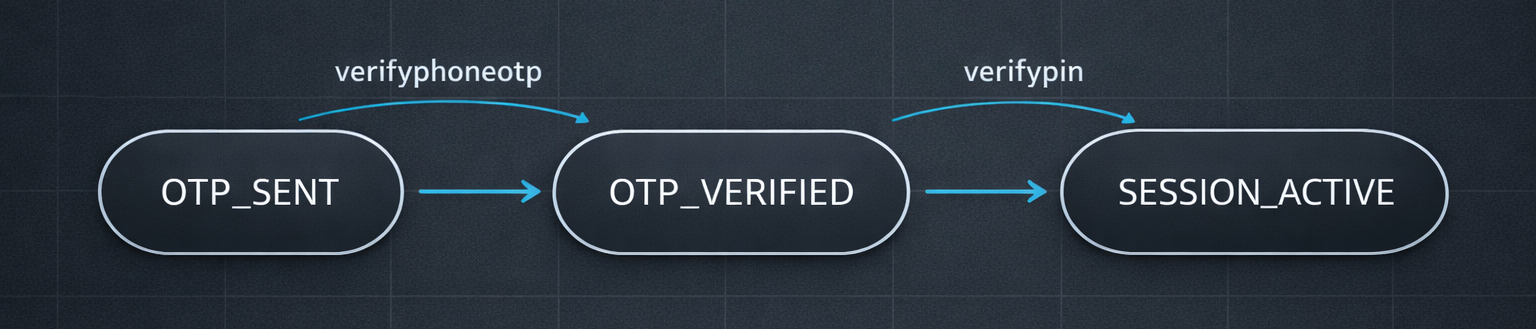
If you model the states (OTP_SENT, OTP_VERIFIED, SESSION_ACTIVE), the headers fall into place.
Environment Awareness (UAT vs PROD)#
We run separate base URLs:
- UAT:
https://uatapi.nubra.io - Production:
https://api.nubra.io
Keep the base URL and device ID explicit in configuration rather than buried in helper code.