
Most trading outages aren't caused by missing features. They're caused by predictable failures handled poorly.
We keep our error shapes and rate limits simple on purpose. If you align your client behavior with that contract, you'll avoid most avoidable incidents.
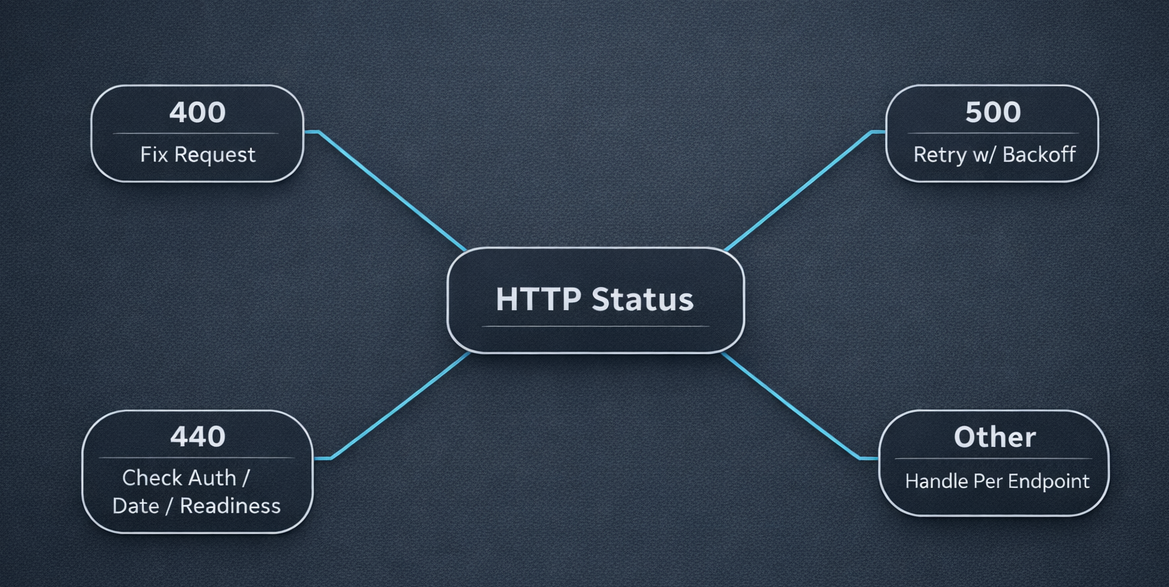
The Error Contract Is Simple (Use It)#
Our APIs return errors in a consistent schema:
{
  "error": "Description of the issue",
  "nubra_error_code": ""
}
Two details matter:
erroris the human-readable explanationnubra_error_codeis reserved and may be empty
Build your client so it does not depend on nubra_error_code being populated.
400 vs 500: Handle Them Differently#
We separate client errors from server errors.
400 � Bad Request#
400 responses mean the request is invalid or violates business rules. Common causes include:
- Missing required fields
- Invalid parameters or enums
- Invalid
ref_id - Quantity or price limit breaches
- STOPLOSS orders without trigger price
- Invalid basket/flexi structures
- Malformed JSON
Example:
{
  "error": "You cannot place this trade as it exceeds the maximum order quantity limit of 100000000",
  "nubra_error_code": ""
}
On 400, the right move is usually to fix the request, not retry it.
500 � Internal Server Error#
500 responses indicate an unexpected backend or OMS failure. In these cases, retrying after a short delay with bounded exponential backoff for automation is appropriate.
440 in EOD Report Flows#
On our bhavcopy/report endpoints, you may see HTTP 440 in cases like:
- Bhavcopy not generated yet
- Future or invalid date
- Invalid or expired session
Bhavcopy endpoint:
GET /bhavcopy/nse/{date}?format=csv&type={type}Keep {date} and the date embedded in type aligned.
Rate Limits Are Part of Reliability#
Our limits are part of the system�s safety envelope:
- Trading APIs (PROD): 10 ops/sec (per IP address)
- Trading APIs (UAT): 100 ops/sec
- Historical Data (REST): 60 requests/min
- WebSocket: weight-based subscription limits
These constraints should shape how you schedule, batch, and retry.
A Practical Retry Posture That Works Well#
Use different behaviors per class of failure:
- On 400: stop and correct the request
- On 500: retry with bounded exponential backoff
- On 440 (bhavcopy/EOD): re-check auth, date correctness, and readiness timing
- Under rate limits: slow down before retrying
Minimal pseudocode policy:
if status == 400: stop and log validation error
elif status == 500: retry with exponential backoff
elif status == 440: re-check auth/date/readiness, then retry later
else: handle per endpoint contract
Defensive Patterns That Reduce Noise#
- Validate STOPLOSS and ICEBERG requirements before submission
- Keep date and
typealigned on bhavcopy requests - Treat OPS limits as a hard envelope for trading loops
- Budget WebSocket subscriptions using weights
This isn�t about clever retry logic. It�s about staying inside the contract so your systems behave predictably.