
Trading APIs are not a direct line to the exchange.
They are a controlled entry point into a broker's responsibility surface.
If you're a developer, this matters because the broker's constraints are not friction. They are the product.
First, What a Trading API Is Not#
A trading API is not:
- A bypass around broker risk
- A guaranteed execution channel
- A substitute for exchange membership rules
A trading API is an invitation to submit intent � subject to broker validation, throttling, and intervention.
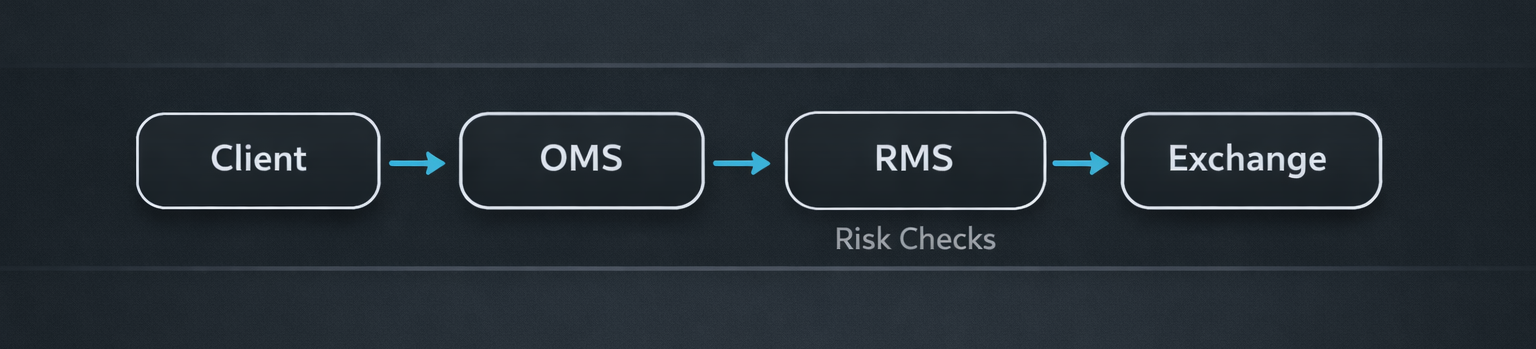
The Order Lifecycle (Client ? OMS ? RMS ? Exchange)#
Most order problems become obvious once you think in stages.
Stage 1: Client Intent Formation#
This is where the majority of broken assumptions are born:
- Wrong instruments
- Wrong scaling
- Underspecified order types
- Missing context for baskets and algos
Stage 2: OMS Normalization#
The OMS converts diverse client requests into a broker-controlled internal representation.
This is where brokers impose:
- Field defaults
- Canonical enums
- Broker-level tagging
- Strategy/basket metadata
Stage 3: RMS Enforcement#
RMS is where the broker earns the right to offer APIs at all.
RMS is responsible for answering questions like:
- Should this order be allowed now?
- What is the risk if it partially fills?
- Does it violate broker or exchange controls?
Stage 4: Exchange Routing and Exchange Reality#
After all the internal work, the exchange still decides what fills and when.
From a broker perspective, �routing success� is not success.
Fill behaviour and post-trade state are what matter.
Authentication, Rate Limits, Tagging, and Controls#
The engineering mistake is to treat these as �API chores.� They are broker controls.
Four controls matter more than most teams admit:
- Authentication context: token + device identity is risk context
- Rate limits: a market conduct control, not just infra protection
- Tagging: the thread that ties audit, strategy, and intervention together
- Order-type constraints: broker-level enforcement of exchange reality
A minimal order payload can look deceptively simple:
payload = {
  "ref_id": ref_id,
  "order_type": "ORDER_TYPE_REGULAR",
  "order_qty": qty,
  "order_side": "ORDER_SIDE_BUY",
  "price_type": "MARKET",
  "exchange": "NSE"
}
trade.create_order(payload)
The serious work happens around this call, not inside it.
What SEBI Regulates vs What Developers Misunderstand#
Developers often misunderstand two things:
-
�If my OPS is low, it isn�t really algo.�
It is still automated API trading and is treated accordingly. -
�If a vendor hosts it, the vendor owns it.�
The broker still owns the responsibility surface.
In regulated markets, responsibility is not assigned by code authorship. It is assigned by market access.
The Uncomfortable Truth: Brokers Remain Responsible#
If you�re building broker APIs, design like you will need to defend every failure mode later.
That changes how you build:
- You prefer determinism over cleverness
- You prefer explicit errors over permissive guesses
- You treat partial fills as a first-class risk state
Trading APIs are not just developer products. They are risk products with a developer interface.