GIFT Nifty is the US dollar-denominated Nifty derivatives contract traded on NSE International Exchange, or NSE IX, in GIFT City. I look at it as more than a pre-market number. It is a bridge between Indian equity-market expectations and global trading hours. For years, many Indian traders watched SGX Nifty before the domestic market opened…
GIFT Nifty is the US dollar-denominated Nifty derivatives contract traded on NSE International Exchange, or NSE IX, in GIFT City. I look at it as more than a pre-market number. It is a bridge between Indian equity-market expectations and global trading hours.
For years, many Indian traders watched SGX Nifty before the domestic market opened because it gave an early signal of how Nifty 50 sentiment was developing outside Indian market hours. After the migration to GIFT City, the same broad idea continues through GIFT Nifty, but the venue is now inside India’s International Financial Services Centre framework.
That distinction matters. GIFT Nifty is not the domestic Nifty 50 index itself. It is a derivatives contract linked to Nifty, traded in dollar terms, and used by different participants for different reasons. When we understand who is active and why, we can read the contract more carefully.
What Is GIFT Nifty?
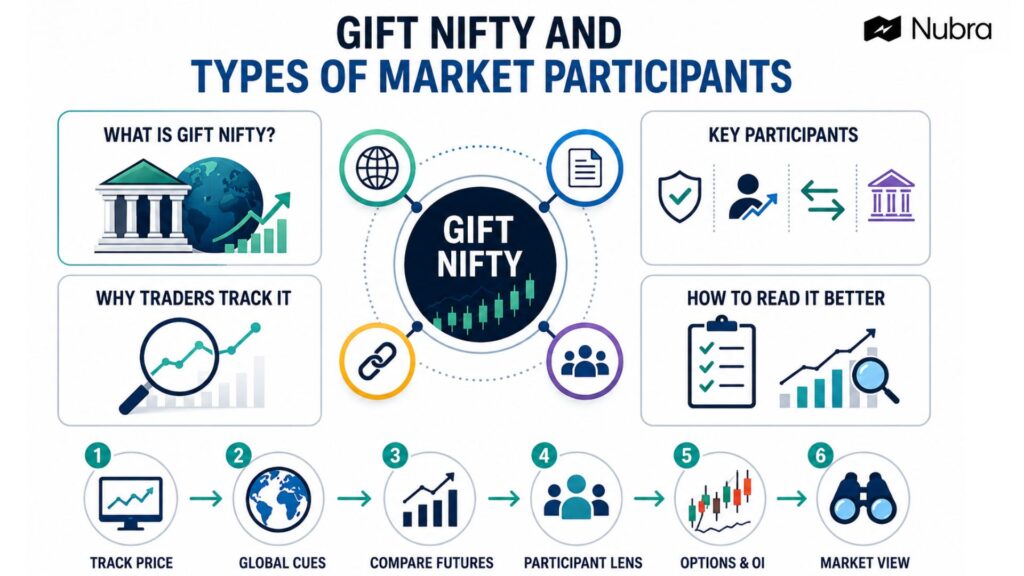
GIFT Nifty refers to Nifty-linked derivative contracts traded on NSE IX at GIFT City in Gujarat. The earlier SGX Nifty contracts were moved from Singapore Exchange to NSE IX and renamed GIFT Nifty after the required regulatory approvals and exchange arrangements.
The contract is useful because it trades for extended hours and overlaps with Asian, European, and US market sessions. In simple terms, it lets global participants react to overnight cues before the Indian cash market opens.
I would not read it as a perfect prediction tool. Domestic pre-open orders, local news, liquidity, institutional flows, currency moves, and expiry positioning can all change the opening picture. But as an early sentiment indicator, it remains important for traders who prepare before the Indian market opens.
GIFT Nifty Vs Nifty 50 Vs Nifty Futures
The easiest way to avoid confusion is to separate the index from the tradable contracts.
| Instrument | What it represents | Where it trades | How I would use it in analysis |
|---|---|---|---|
| Nifty 50 | The benchmark index of 50 large Indian companies | NSE India | To understand the live domestic index level |
| Nifty futures | A domestic INR-denominated futures contract on Nifty | NSE India derivatives segment | To track domestic futures sentiment, basis, rollover, and expiry behaviour |
| GIFT Nifty | A USD-denominated Nifty-linked derivatives contract | NSE IX, GIFT City | To read extended-hours global sentiment around Indian equities |
| SGX Nifty | The earlier Singapore-listed Nifty futures reference | Singapore Exchange, before migration | Now mainly relevant as historical context |
This comparison is important because many traders casually say, “GIFT Nifty is up, so Nifty will open up.” I prefer a more careful version: GIFT Nifty shows how Nifty-linked futures are being priced during extended global hours. It is still one input in the pre-market checklist.
Why Traders Track GIFT Nifty Before Market Open
GIFT Nifty is useful because the Indian market does not trade in isolation. If Nasdaq sells off, US bond yields move, or crude oil rises after Indian hours, GIFT Nifty gives us an early place to see whether those cues are being priced into Nifty-linked futures.
The mistake is to treat every point move as a direct trading instruction. I usually ask whether GIFT Nifty is confirming global risk-on or risk-off sentiment, or diverging from other cues.
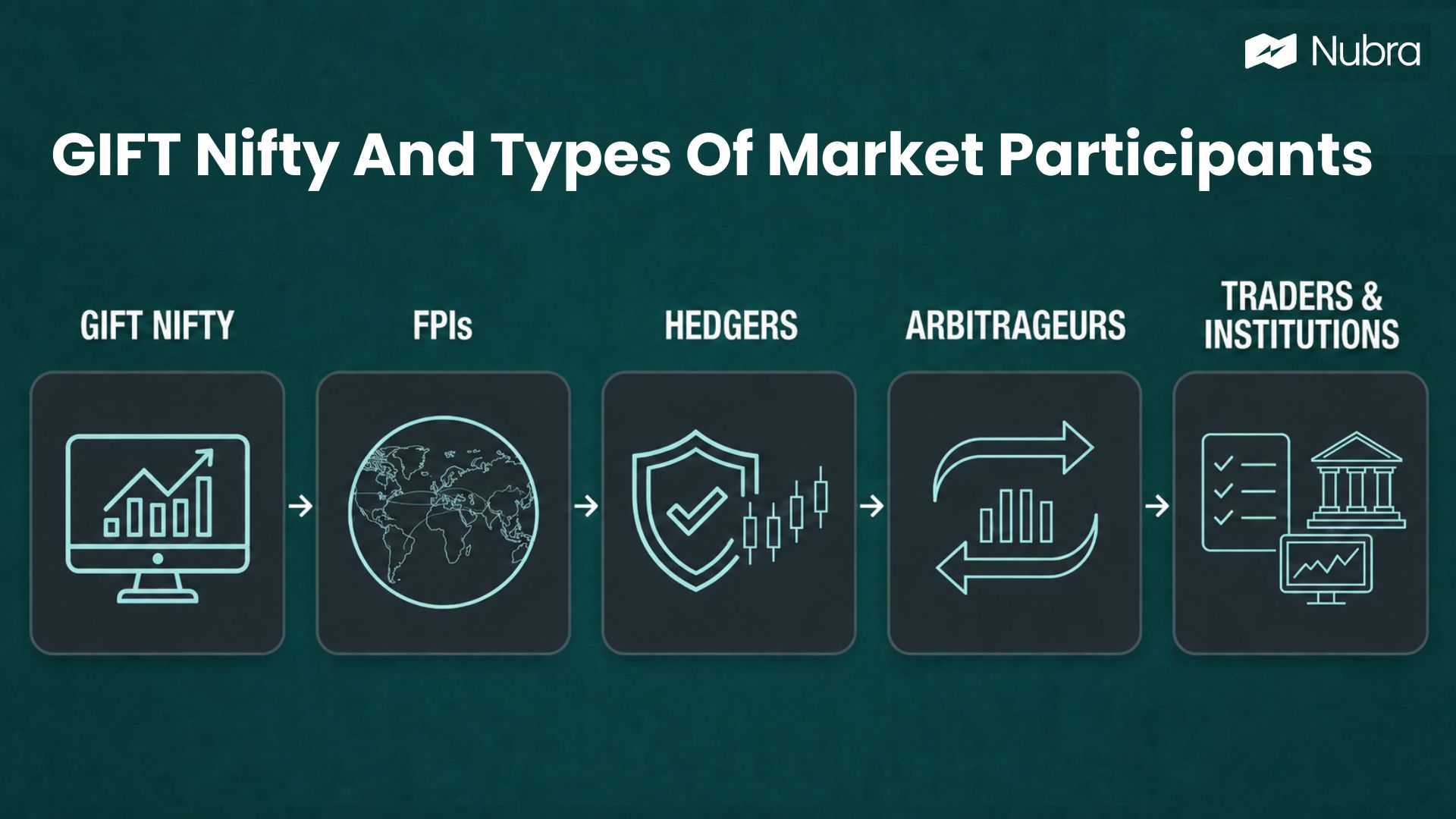
Main Types Of Market Participants In Derivatives
Derivatives markets are shaped by different participants with different objectives. The same price movement can mean different things depending on who is active.
Hedgers
Hedgers use derivatives to reduce exposure to an underlying market risk. A portfolio manager with Indian equity exposure may use index futures to reduce downside risk before a major event.
In GIFT Nifty, hedging can be especially relevant because of the extended trading window. If a global fund has India exposure and US markets drop after NSE closes, a Nifty-linked contract can help the participant adjust exposure earlier.
For a retail trader studying the market, this means not every short position is a bearish speculative call. Some shorts may be hedges against a larger long portfolio.
Speculators And Directional Traders
Speculators take a view on price movement. In futures, the attraction is leverage: a participant can get index exposure by paying margin rather than the full notional value of the contract.
Leverage cuts both ways. For educational purposes, assume a trader takes a futures position with a 10% margin requirement. A 1% adverse move in the underlying can translate into a much larger percentage impact on the margin deployed.
I do not want to simply know that GIFT Nifty is up or down. I want to know whether the move is large relative to recent volatility, whether global indices support it, and whether domestic Nifty futures later confirm it.
Arbitrageurs
Arbitrageurs look for price differences between related markets or instruments. In index derivatives, they may watch the relationship between futures and spot, GIFT Nifty and domestic Nifty futures, currency-adjusted pricing, or expiry differences.
Suppose GIFT Nifty is pricing a materially different implied level from domestic Nifty futures once Indian derivatives open. If the difference is large enough after costs, currency, execution, and timing risk, arbitrage-oriented participants may try to capture that spread.
Sharp differences between related Nifty instruments may not last if professional participants can trade both sides efficiently. For normal traders, costs, access, latency, margins, and execution risk can remove the apparent opportunity.
Institutional Participants
Foreign portfolio investors, domestic institutions, banks, funds, and proprietary desks can all influence derivatives activity. Their objectives are not identical. A foreign investor may hedge India exposure. A proprietary desk may trade spreads, volatility, or short-term price movement. A client account may reflect retail or high-net-worth participation routed through a broker.
This is why participant data is useful but easy to misuse. If FIIs are net short index futures, it can suggest caution, but it does not automatically mean the market must fall. I would rather combine participant data with open interest, price action, volatility, and event context than treat it as a standalone signal.
Market Makers And Liquidity Providers
Market makers and liquidity providers help maintain tradable order books by quoting buy and sell prices. In some exchange schemes, these participants have formal quoting obligations around size, spread, and presence during specified hours.
For a trader, liquidity affects execution quality. A contract may show an attractive indicative move, but if spreads are wide or depth is thin, real execution can differ from the screen impression.
How I Read GIFT Nifty Alongside Participant Behaviour
I usually separate the reading into three layers.
First, I look at the price signal. Is GIFT Nifty indicating a gap-up, gap-down, or flat open for Nifty?
Second, I compare it with global context. A GIFT Nifty rise alongside strong US futures, stable Asian markets, and supportive currency movement is different from a rise that appears isolated.
Third, I think about participant behaviour. A large move near a global event may reflect hedging. A fast move with high volume may show active directional trading. A quick narrowing between GIFT Nifty and domestic futures may suggest arbitrage activity.
This layered reading is more useful than a single-line conclusion such as “GIFT Nifty is positive.”
Where Nubra Fits Into This Workflow
For an active trader, the value is not only in tracking GIFT Nifty. The value is in building a repeatable pre-market process that includes global cues, GIFT Nifty movement, domestic Nifty futures, option-chain positioning, open interest changes, expected volatility, and strategy scenarios. Nubra’s content and trading workflow can support this kind of analytical approach by helping traders think through market context, option-chain signals, open interest changes, and scenario planning more clearly, without treating any single indicator as a trading instruction.
The key is restraint. Tools can organize data and improve analysis, but they do not remove market risk. This article is for education only and should not be treated as investment advice.
FAQs
What is GIFT Nifty?
GIFT Nifty is a Nifty-linked derivatives contract traded on NSE IX in GIFT City. It replaced the earlier SGX Nifty reference after Nifty derivatives trading migrated from Singapore to India’s IFSC framework.
Why do traders track GIFT Nifty?
Traders track it because it reflects Nifty-linked sentiment during extended global trading hours. It can provide an early indication of how the Indian market may open, but it does not guarantee the actual opening or intraday direction.
Is GIFT Nifty the same as Nifty 50?
No. Nifty 50 is the underlying benchmark index. GIFT Nifty is a derivative contract linked to Nifty and traded on NSE IX in US dollar terms.
Who participates in GIFT Nifty and derivatives markets?
Common participant types include hedgers, speculators, arbitrageurs, institutions, proprietary desks, clients, market makers, and liquidity providers. Each group may trade for a different reason, so the same price move can have multiple interpretations.
Can Indian retail investors trade GIFT Nifty?
Access depends on applicable rules, eligibility, broker arrangements, and regulatory restrictions. Indian residents should verify the latest rules with qualified sources and their broker before assuming they can trade GIFT Nifty directly.
How should I use GIFT Nifty in a pre-market checklist?
Use it as one input. Compare it with global indices, currency moves, commodities, domestic news, Nifty futures, option-chain data, and open interest before forming a market view.
Disclaimer: The information provided in this blog is for educational and informational purposes only and should not be construed as investment advice, financial advice, or a recommendation to buy, sell, or hold any securities or financial products. Investments in the securities market are subject to market risks. Please read all related documents carefully before investing. Readers should conduct their own research and consult a SEBI-registered investment adviser or other qualified financial professional before making any investment decisions. Past performance is not indicative of future results.