A strangle option strategy is a two-leg options strategy where we use one call option and one put option on the same underlying and expiry, but with different strike prices. The call strike is usually above the current market price, and the put strike is usually below it. The strategy is mainly used to take…
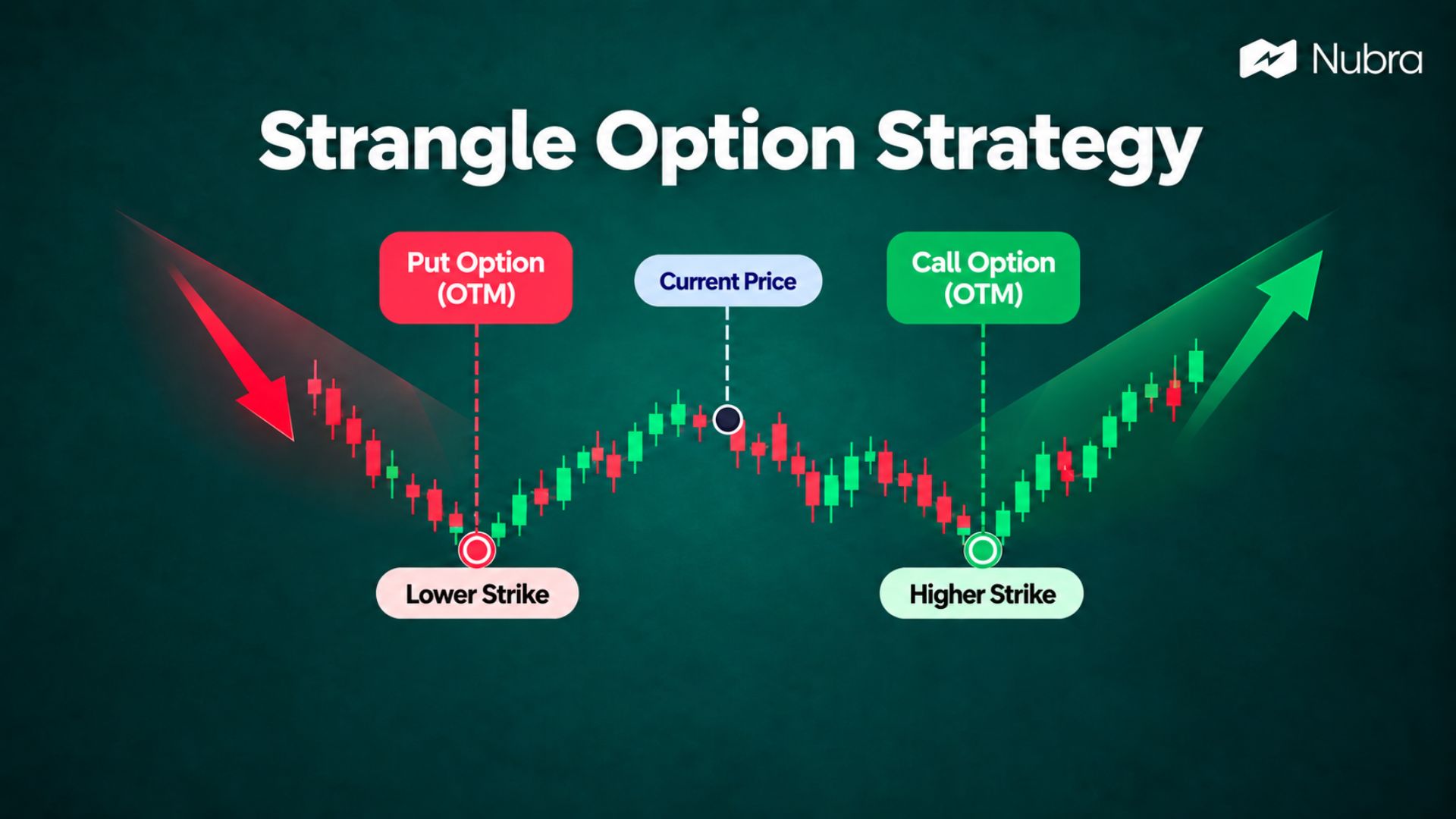
A strangle option strategy is a two-leg options strategy where we use one call option and one put option on the same underlying and expiry, but with different strike prices. The call strike is usually above the current market price, and the put strike is usually below it.
The strategy is mainly used to take a view on volatility. In a long strangle, we buy both options and need a large move in either direction. In a short strangle, we sell both options and need the underlying to stay within a range. The setup looks simple, but the risk changes completely depending on whether we are buying or selling the options.
This guide is for educational purposes only and should not be treated as investment advice. Options trading involves market risk, and outcomes depend on volatility, expiry, liquidity, execution, brokerage, taxes, and individual decisions.
What Is a Strangle Option Strategy?
A strangle option strategy combines:
- One out-of-the-money call option
- One out-of-the-money put option
- The same underlying
- The same expiry
- Different strike prices
For example, if Nifty is trading near 22,000, a trader may study the 22,300 call and the 21,700 put for the same weekly expiry. If both options are bought, it becomes a long strangle. If both options are sold, it becomes a short strangle.
The reason traders study a strangle is that it separates direction from movement. Instead of asking only whether the market will rise or fall, we are asking whether the market can move enough, or stay calm enough, before expiry.
If you are comparing this with a straddle, the difference is the strike selection. A straddle options strategy uses the same strike for the call and put. A strangle uses two different strikes, usually away from the current price.
How Does a Strangle Strategy Work?
In a long strangle, we pay premium to buy the call and the put. The position can benefit if the underlying moves sharply above the call strike or sharply below the put strike. If the underlying stays between the two strikes until expiry, both options can expire worthless and the premium paid may be lost.
In a short strangle, we receive premium by selling the call and the put. The position can benefit if the underlying stays between the two strikes and both options lose value with time decay. The risk is that a strong move on either side can create losses beyond the premium received.
This is why a strangle should not be read only as “buy both sides” or “sell both sides”. The real questions are: how much premium is paid or received, where the breakevens are, how much time is left to expiry, and whether implied volatility is expensive or cheap for the expected move.
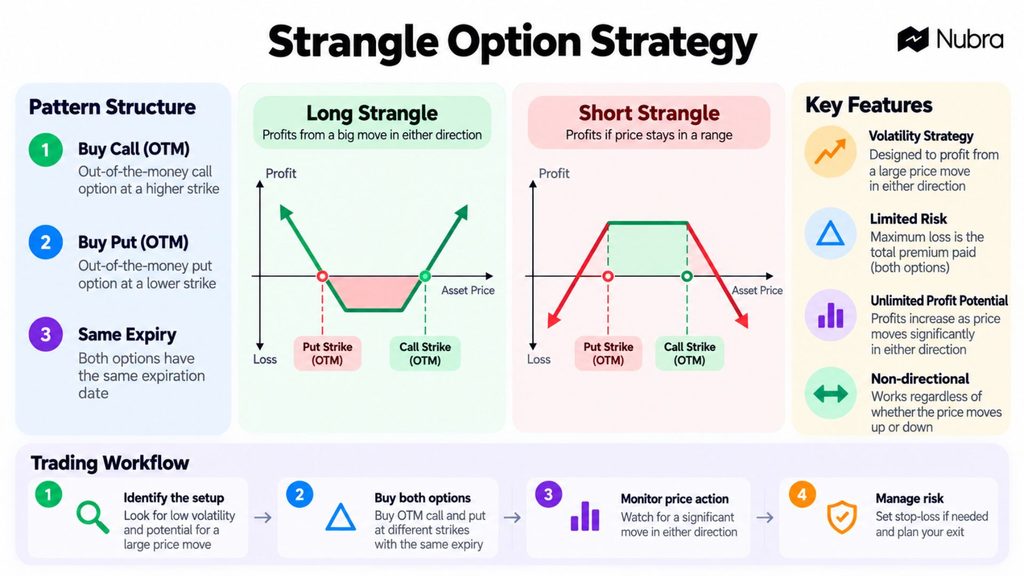
Long Strangle vs Short Strangle
| Factor | Long Strangle | Short Strangle |
|---|---|---|
| Position | Buy an out-of-the-money call and put | Sell an out-of-the-money call and put |
| Market view | Large move expected, direction uncertain | Range-bound or low-movement view |
| Premium flow | Premium is paid | Premium is received |
| Maximum loss | Limited to total premium paid | Can be high if the market moves sharply |
| Maximum profit | Potential payoff can increase on a large upside move and can be meaningful on a large downside move | Limited to premium received |
| Breakeven | Call strike + total premium; put strike – total premium | Call strike + total premium received; put strike – total premium received |
| Main risk | Market does not move enough before expiry | Market moves outside the expected range |
| Volatility impact | Rising implied volatility may help | Rising implied volatility may increase risk |
The long strangle usually costs less than a long straddle because both options are out of the money. The trade-off is that the market has to move further before the position reaches breakeven. The short strangle may look attractive because premium is received upfront, but that premium is not guaranteed income. A sudden gap, trend day, event move, or volatility spike can change the payoff quickly.
Strangle Option Strategy Example
Let us use a simple Nifty-style example.
Assume Nifty is trading near 22,000 and we are looking at the same weekly expiry.
| Option leg | Action in a long strangle | Premium |
|---|---|---|
| 22,300 Call | Buy | ₹90 |
| 21,700 Put | Buy | ₹80 |
| Total premium paid | ₹170 |
For the long strangle, the total cost is ₹170. The breakeven levels are:
| Breakeven | Formula | Level |
|---|---|---|
| Upper breakeven | 22,300 + 170 | 22,470 |
| Lower breakeven | 21,700 – 170 | 21,530 |
This means Nifty needs to move above 22,470 or below 21,530 by expiry before the position turns profitable, excluding brokerage, taxes, slippage, and execution differences. If Nifty expires between 21,700 and 22,300, both options may expire worthless and the full premium can be lost.
For a short strangle, the trade is reversed. We sell the 22,300 call and the 21,700 put and receive ₹170. The maximum gain is the premium received if both options expire worthless. But if Nifty moves above 22,470 or below 21,530, losses can start building beyond the premium collected.
When Traders Study a Strangle
A long strangle is usually studied when a large move is expected, but the direction is uncertain. This can happen around major results, policy events, index breakouts, compressed volatility, or periods where the chart is close to an important range edge.
The difficult part is timing. If the expected move comes too late, time decay can reduce option value. If implied volatility is already high, the market may move and the trade may still disappoint if premiums cool after the event. That is why the entry premium matters as much as the directional uncertainty.
A short strangle is usually studied when the market is expected to remain inside a range. Traders may look at support and resistance, option-chain open interest, India VIX, time to expiry, liquidity, and planned exits before even considering it. The position needs close monitoring because the payoff can become uncomfortable when one strike is tested or crossed.
For a wider strategy overview, Nubra’s guide on 10 options strategies every investor should know explains how different options structures are linked to market view, volatility view, premium, and risk.
What to Check Before Reading a Strangle Setup
Before studying a strangle, it helps to calculate the total premium first. That premium tells us the movement needed for a long strangle and the cushion available in a short strangle. The next step is to mark both breakevens and compare them with the recent trading range, support and resistance, event calendar, and expiry timing.
The option chain can be useful here because strike-level premiums, open interest, implied volatility, Greeks, and volume help frame the setup. Nubra’s Option Strategy Builder guide is also relevant because payoff diagrams make it easier to see how the same strikes behave under different price scenarios.
Charts matter too. Nubra’s Charts help traders review trend, range, support, resistance, and breakout context before the options structure is studied. A strangle may look clean on paper, but it should still be checked against actual price behaviour.
The key point is simple: tools can support analysis, but they do not make the strategy profitable by themselves. The trade still depends on the trader’s view, sizing, timing, risk control, and execution.
Benefits and Risks of a Strangle Strategy
A strangle can be useful because it gives a structured way to study volatility. A long strangle lets us evaluate a large-move view without choosing the direction upfront. A short strangle lets us evaluate a range-bound view where time decay is the main idea.
The risks are just as important. A long strangle can lose the full premium if the market stays quiet. It can also struggle if the move is smaller than expected or if implied volatility falls after entry. A short strangle can lose much more than the premium received if the market moves sharply. In Indian F&O markets, liquidity, lot size, margin, bid-ask spread, expiry-day movement, and sudden news can also affect the final result.
This is why a strangle should be treated as a strategy to analyse, not a shortcut. We need to know the breakevens, the invalidation plan, and the possible loss before thinking about the possible payoff.
FAQs
What is a Strangle Option Strategy?
A strangle option strategy uses one call option and one put option with the same underlying and expiry, but different strike prices. It can be created by buying both options or selling both options.
What is the Difference Between a Long Strangle and a Short Strangle?
In a long strangle, we buy the call and put and need a large move to cover the premium paid. In a short strangle, we sell the call and put and benefit if the underlying stays within a range, but the risk can be high if the market moves sharply.
How do We Calculate Breakeven in a Long Strangle?
For a long strangle, the upper breakeven is the call strike plus the total premium paid. The lower breakeven is the put strike minus the total premium paid.
Is a Strangle Cheaper Than a Straddle?
A long strangle is usually cheaper than a long straddle because both options are out of the money. The trade-off is that the underlying must move further before the strategy reaches breakeven.
Is a Short Strangle Risky?
Yes. A short strangle can be risky because losses may grow if the underlying moves sharply above the call strike or below the put strike. The premium received is limited, but the loss can be much larger.
When Do Traders Study Strangle Strategies?
Traders usually study long strangles when they expect a large move but are unsure of direction. They study short strangles when they expect the market to remain within a defined range. Both setups require careful risk assessment.
Disclaimer: The information provided in this blog is for educational and informational purposes only and should not be construed as investment advice, financial advice, or a recommendation to buy, sell, or hold any securities or financial products. Investments in the securities market are subject to market risks. Please read all related documents carefully before investing. Readers should conduct their own research and consult a SEBI-registered investment adviser or other qualified financial professional before making any investment decisions. Past performance is not indicative of future results.