A price on our screen can change before our order reaches the market. That delay matters in fast-moving instruments such as index futures and options. Low latency trading aims to shorten the journey from receiving market data to handling an order. We need to understand each stage to judge where speed helps and what it…
A price on our screen can change before our order reaches the market. That delay matters in fast-moving instruments such as index futures and options.
Low latency trading aims to shorten the journey from receiving market data to handling an order. We need to understand each stage to judge where speed helps and what it cannot solve.
What Is Low Latency Trading?
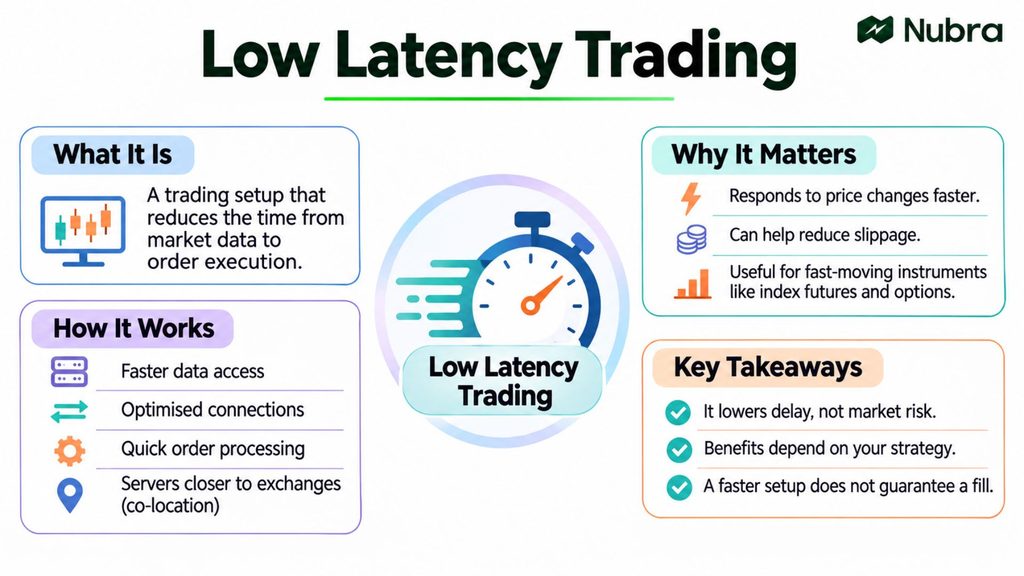
Low latency trading means designing trading systems and connections to minimise the time between a market event, a trading decision and the resulting order messages. Those messages can submit, amend or cancel orders.
Latency is simply delay. We usually describe it in milliseconds or microseconds: one millisecond is one-thousandth of a second, while one microsecond is one-millionth. A useful number must specify which part of the process it measures.
We should distinguish low latency from automation. An algorithm follows programmed trading rules; low latency describes how quickly the surrounding system handles information and actions. An automated strategy can still be slow. Our guide to the basics of algorithmic trading explains that broader process.
Where Does Trading Latency Come From?
We can trace a delay through four stages before deciding what needs improvement.
Market Data Reaches Our System
A price or order-book change must travel from the exchange through the relevant data service to our application. The application then processes and displays it.
We check data freshness as well as screen responsiveness. The last traded price records an earlier transaction; it does not guarantee the price of our next fill.
We Form and Send an Instruction
For manual trading, reading the market and entering an order take time. For an algorithm, calculations, data handling and software dependencies contribute to the delay.
Waiting for a candle to close may be part of our strategy. We distinguish that deliberate wait from avoidable processing delays.
The Broker Handles the Order
The instruction travels through network connections and broker systems. Order management, applicable risk checks and exchange connectivity all form part of this route.
An API response may confirm receipt by the broker. We check the documented status separately for exchange acceptance and execution.
The Exchange Matches Available Orders
An accepted order still needs a matching counterparty at a compatible price. It may fill immediately, fill in parts or remain unfilled, depending on its conditions and the order book.
Our price, quantity and available liquidity help determine the fill, alongside submission speed.
Why Does Low Latency Matter?
Lower delay helps us respond while the information behind a decision is still relevant. Its value depends on our strategy: frequently updating quotes has different timing needs from holding a position for several days.
Price Changes and Slippage
Slippage is the difference between an expected trading price and the price actually achieved. Delay can contribute to it, but so can a wide bid–ask spread, limited quantities and rapid price movement.
Suppose we expect to buy a hypothetical option at ₹100, but the average fill is ₹101.50. Across 100 units, the adverse difference is ₹150 before charges. The quantity is illustrative and does not represent a current contract lot size.
To establish whether latency contributed, we would need the quotes, quantities and timestamps around the order. A faster connection would not necessarily have prevented the difference.
Changing Quotes and Incomplete Positions
In a multi-leg options structure, one leg can fill while another remains open, leaving us exposed as the market moves. Faster submission does not make separate fills simultaneous; we still need a plan for partial fills and a missing hedge.
An order can also execute before a cancellation request is processed. We check the confirmed status rather than assume our click cancelled it.
Our guide to fast trade execution explores fills and execution quality in more detail.
How Does Low Latency Trading Technology Work?
We improve latency by addressing the components that contribute most to the delay.
Network Design and Server Location
Network routes, physical distance and intermediate systems influence how quickly messages travel. Dedicated connectivity and carefully chosen server locations can reduce avoidable delays in an institutional setup.
Co-location places trading infrastructure within an exchange facility, subject to its access arrangements. Proximity hosting places infrastructure nearby. Both address physical distance, but neither removes every processing step or guarantees a fill.
We should not equate a cloud server in a particular city with exchange co-location; the actual connection and access arrangement matter.
Market Data and Processing
Different data products deliver different levels of detail. A chart update, a price snapshot and an order-book feed are not interchangeable inputs.
Our data must suit the strategy, and our system must process it correctly while detecting interruptions or missing information.
We check documented update behaviour, timestamps and recovery procedures. The label “real-time” alone does not establish a measured delivery delay.
Efficient Software and Hardware
We can measure time spent reading messages, calculating signals and preparing orders. Non-essential tasks, such as writing a detailed report, can run separately where the architecture permits.
Specialist firms may also use purpose-built networking hardware. However, a hardware upgrade cannot repair incorrect trading logic or establish that a strategy has an advantage.
We measure where time is spent before upgrading, then test whether the change improves performance without disrupting order handling.
Order Routing and Resilience
Order handling must remain correct when messages are delayed, rejected or interrupted. A system that responds quickly during a quiet test may behave differently under heavy demand.
If a submission times out, we should not assume it failed and send another order immediately. The first instruction may already exist. Checking order identifiers, statuses and positions helps avoid unintended duplicates.
We need dependable recovery as well as speed, particularly when tracking open positions.
Who Uses Low Latency Trading?
Market makers use responsive systems to revise quotes as conditions change. Arbitrage strategies may depend on acting before a price difference disappears, although execution costs and incomplete trades can undermine the expected opportunity.
High-frequency trading firms place particular emphasis on rapid data processing and order handling. Low latency is a technical requirement for many such strategies, but it is not evidence that every strategy will be profitable.
Institutional execution teams may also examine timing when managing large orders. Their objective can include controlling market impact and completing an order over time, rather than sending the entire quantity as quickly as possible.
As retail traders, we need evidence that delays affect our strategy before investing in specialist infrastructure.
How Should We Assess Low Latency Trading in India?
We should distinguish ordinary broker access from specialist exchange infrastructure. A trading API provides a way for software to interact with a broker; its existence does not establish co-location or direct market access.
Direct market access is a defined access arrangement, not a general promise to bypass broker controls. We need to verify eligibility, permissions and the applicable requirements through current official information before considering any specialist arrangement.
For retail automation, we should also confirm the broker’s current onboarding, authentication and supported integration requirements. An older tutorial may describe a setup that no longer matches the available service.
Moving our system to another server changes part of the route and adds hosting, monitoring and recovery responsibilities. We weigh those demands against a measured need.
How Can We Measure Trading Latency Properly?
We specify the start and end points of each measurement:
- Data arrival delay: how long market information takes to reach the receiving system, where comparable timestamps are available.
- Decision time: the interval between receiving an input and producing a trading instruction.
- Submission-to-acknowledgement time: the interval between sending an order and receiving a specified acknowledgement.
- Time to first fill: the interval until some quantity executes.
- Time to complete fill: the interval until the requested quantity has executed, if it completes.
A broker’s internal processing figure and our full click-to-fill time cover different journeys. We compare figures only when their boundaries match.
Look Beyond the Average
An average can hide occasional long delays. The median describes the middle observation; the 95th percentile describes a value at or below which 95% of recorded observations fall.
If delays rise sharply during busy periods, a quiet-session average gives an incomplete picture. We should examine the sample size, trading period, instruments, rejected requests and any excluded observations.
We also check that clocks on different machines are comparable; otherwise, clock differences can distort the apparent delay.
Compare Like with Like
We keep order size, liquidity, network route and measurement boundaries as consistent as possible when comparing results.
Paper trading and simulated environments can help test logic and recovery. They do not reproduce every live queue, available quantity or fill condition. Our article on algorithmic and automated trading for intraday explains why strategy rules and realistic execution assumptions need to be assessed together.
What Can We Improve Before Adding Specialist Infrastructure?
We start with our device and connection: close unnecessary background applications, simplify overloaded layouts and test a wired connection where practical.
Next, we review the trading records. Does the delay occur before submission, while awaiting acknowledgement or after acceptance? Are poor fills concentrated in instruments with wider spreads or limited quantities?
We also check how the order type fits the intention. A limit order controls the acceptable execution price, but it can remain unfilled. A market order seeks execution against available liquidity, with less certainty about the final price. The available order types and their conditions must be confirmed with the broker.
We assess the full cost: hosting, data, software, brokerage, applicable charges and slippage. Faster technology cannot establish that an untested trading idea will work.
Where Do Nubra’s Tools Fit?
With Nubra Option Chain, we can examine strike-level information such as open interest, volume, implied volatility and Greeks. These help us understand the contracts we are studying; high open interest alone does not establish that our order will fill at the displayed price.
Nubra Strategy Builder supports the review of options payoff scenarios. We still need to consider the difference between a modelled structure and the prices available when its legs execute.
Nubra Charts supports the review of price action and relevant levels. Charts and Strategy Builder may require sign-in. These tools serve analysis and planning purposes; they do not establish a particular execution latency or guarantee outcomes.
FAQs
Is Low Latency Trading the Same as High-Frequency Trading?
No. Low latency describes reduced delays in a trading system. High-frequency trading describes strategies that typically depend on rapid processing and frequent order activity. We can improve a retail system’s responsiveness without operating an HFT strategy.
What Is a Good Latency for Trading?
There is no universal threshold. We need to specify the measurement boundaries, strategy and market conditions. A number covering internal broker processing cannot be treated as our full submission-to-fill time.
Does Lower Latency Eliminate Slippage?
No. It may reduce the delay during which prices change, but liquidity, spreads, order size and volatility still affect fills. We should investigate these factors together.
Can a Limit Order Solve Execution Delays?
A limit order sets an acceptable price boundary; it does not remove transmission delays or guarantee execution. We may receive a partial fill or no fill at all.
Do Retail Traders Need Co-Location?
We should establish a measured need before considering specialist infrastructure. A strategy’s holding period, available access arrangements, costs and technical demands determine whether it is relevant.
Do Nubra’s Analysis Tools Guarantee Low Latency Execution?
No. Option Chain, Strategy Builder and Charts support analysis and planning. We should verify any execution-speed claim separately, including what is measured, under which conditions and with which limitations.
Disclaimer: The information provided in this blog is for educational and informational purposes only and should not be construed as investment advice, financial advice, or a recommendation to buy, sell, or hold any securities or financial products. Investments in the securities market are subject to market risks. Please read all related documents carefully before investing. Readers should conduct their own research and consult a SEBI-registered investment adviser or other qualified financial professional before making any investment decisions. Past performance is not indicative of future results.