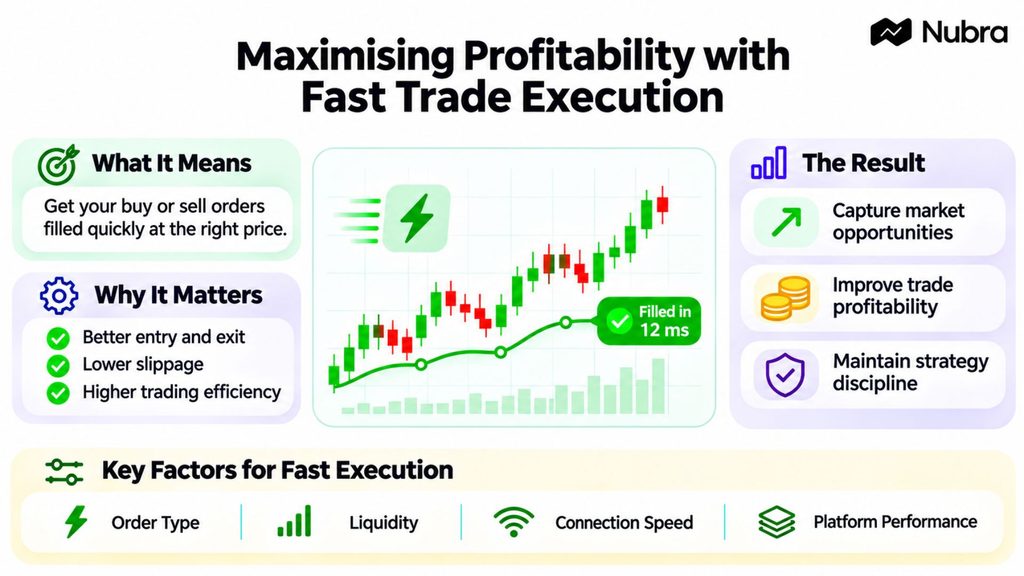
Fast trade execution can help us act before available prices change. But speed alone cannot make a strategy profitable. The price we receive, the quantity filled and the costs of trading all affect our result. When we think about maximising profitability, our focus should be on how much execution changes the outcome of our plan.…
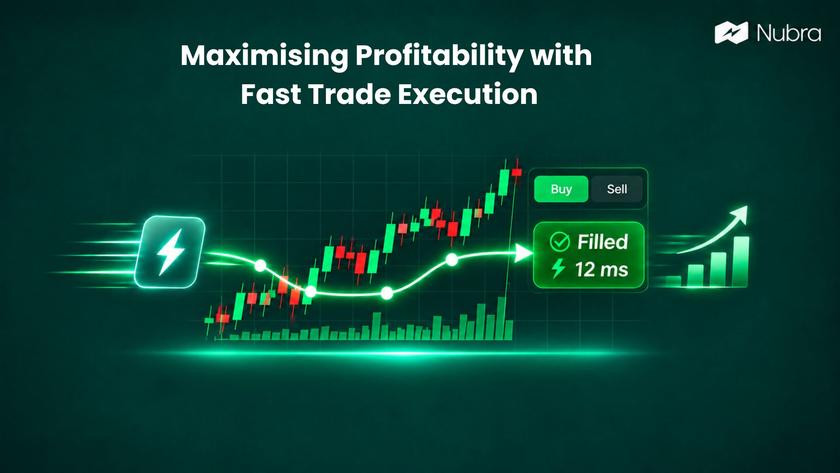
Fast trade execution can help us act before available prices change. But speed alone cannot make a strategy profitable. The price we receive, the quantity filled and the costs of trading all affect our result.
When we think about maximising profitability, our focus should be on how much execution changes the outcome of our plan. We need to understand where delays arise, when price control matters and what actually happens after we submit an order.
What Does Fast Trade Execution Mean?
Trade execution is the matching of our buy or sell order with an opposite order in the market. Execution speed describes how quickly that happens after submission.
Several stages sit between our decision and a completed trade: our device sends the instruction, the broker processes it, and the exchange attempts to match it. Available buyers or sellers determine whether the requested quantity can trade.
An order acknowledgement confirms receipt or acceptance at a particular stage. It does not necessarily mean our trade is complete. An order may remain open, be rejected or fill in parts.
How Execution Affects Our Trading Result
Slippage is the difference between our expected price and the actual execution price. It can work in our favour or against us.
Suppose we plan to buy 100 shares at ₹250 and sell them at ₹253. Our expected gross gain is ₹300. If our purchase instead fills at an average ₹250.80 and we sell at ₹253, the gross gain becomes ₹220, before charges.
The ₹80 difference illustrates adverse entry slippage. It is a hypothetical example, not a forecast or a statement about Nubra’s charges. Slippage on exit could change the result further.
We also need to account for brokerage and applicable charges. Our guide to understanding the risk/reward ratio explains why evaluating potential gains alongside potential losses matters. Execution costs belong in that assessment.
Why Liquidity Matters Alongside Speed
Liquidity describes how readily we can trade a quantity without substantially changing its price. The bid–ask spread is the gap between the highest buying price and the lowest selling price currently quoted.
A fast instruction cannot create liquidity. If the available quantity at the best price is smaller than our order, execution may involve several prices. A last traded price records an earlier transaction; it is not a promise that our next order will receive that price.
For options, we therefore examine the particular strike and expiry, rather than assume every contract on a familiar index trades equally actively.
How Do We Balance Speed And Price Control?
Market and limit orders express different priorities, subject to the platform’s current supported order types and market rules.
A market order seeks execution at available prices. It gives us less control over the final price, particularly when quotes move quickly or available quantities are thin.
A limit order specifies the highest price we will pay when buying or the lowest price we will accept when selling. It provides price control, but may remain partly or entirely unfilled.
We need to decide which uncertainty our plan can accommodate: an uncertain execution price or an uncertain fill. Repeatedly moving a limit to chase the market can also take us beyond the price our original plan allowed.
How We Prepare Before Placing An Order
Preparation can reduce avoidable hesitation and input errors. Before submission, we check:
- The instrument, expiry where relevant, buy or sell direction, and quantity.
- Available funds or margin, current positions and pending orders.
- The order instruction, acceptable price and exit conditions.
- Our connection and the freshness of the information on screen.
Our guide to automated trading platforms explores how predefined rules fit into this process. Automation still needs checks and monitoring; it does not establish that a trade will be profitable.
If an order request times out, we check its status and our actual position before submitting another instruction. A missing confirmation does not prove that the first request failed.
How We Review Execution Quality
We compare the price available when we decided to trade with our average fill price, then review filled quantity, time to completion and charges. We keep the same benchmark definition across trades so comparisons remain useful.
Separating liquid and thinly traded contracts, calm and volatile periods, and small and larger orders helps us investigate differences. One unusually quick fill tells us little about consistency.
For systematic research, our algorithmic trading with Python guide explains why tests need realistic execution assumptions. A simulated fill is not evidence that a live order would achieve the same result.
Where Nubra’s Tools Fit
We can use the Nubra Option Chain to examine contract prices, volume, open interest and Greeks. These inputs support analysis; open interest alone does not establish the quantity available at our intended price.
The Nubra Strategy Builder helps us construct multi-leg options positions and examine payoff scenarios. A modelled payoff depends on its assumptions and can differ from the outcome after actual fills and charges.
Nubra Charts provide price context for reviewing a setup and its timeframe. Charts and the Strategy Builder may require sign-in. These tools support preparation and analysis; they do not guarantee a particular execution speed or result.
FAQs
What is Trade Execution Speed?
It is how quickly an order receives fills after submission. We distinguish the first fill from completion of the full requested quantity.
Does Faster Execution Guarantee Higher Profits?
No. Our strategy, market conditions, prices, costs and risk controls all matter. Faster execution can also complete a losing trade sooner.
Are Market Orders Better Than Limit Orders?
Neither suits every situation. We weigh execution urgency against price control, while checking supported instructions and the possibility of an incomplete fill.
Can Slippage Occur on a Fast Platform?
Yes. Prices and available quantities can change before matching. We cannot assume that lower submission delays remove liquidity constraints or adverse price movements.
Why Do Partial Fills Matter For Options Strategies?
If some legs fill while others remain open, our actual exposure can differ from the planned position. We monitor each leg and the combined position.
How Can We Measure Execution Quality?
We record a consistent reference price, average fill price, filled quantity, completion time and charges. Reviewing comparable trades helps us identify recurring issues.
Disclaimer: The information provided in this blog is for educational and informational purposes only and should not be construed as investment advice, financial advice, or a recommendation to buy, sell, or hold any securities or financial products. Investments in the securities market are subject to market risks. Please read all related documents carefully before investing. Readers should conduct their own research and consult a SEBI-registered investment adviser or other qualified financial professional before making any investment decisions. Past performance is not indicative of future results.