We can plan a trade carefully and still receive a different price when the order fills. The price on a chart is only part of the picture. Available quantities, competing orders and the time taken to reach the exchange also affect execution. Smart order execution brings these decisions together. It concerns how an order is…
We can plan a trade carefully and still receive a different price when the order fills. The price on a chart is only part of the picture. Available quantities, competing orders and the time taken to reach the exchange also affect execution.
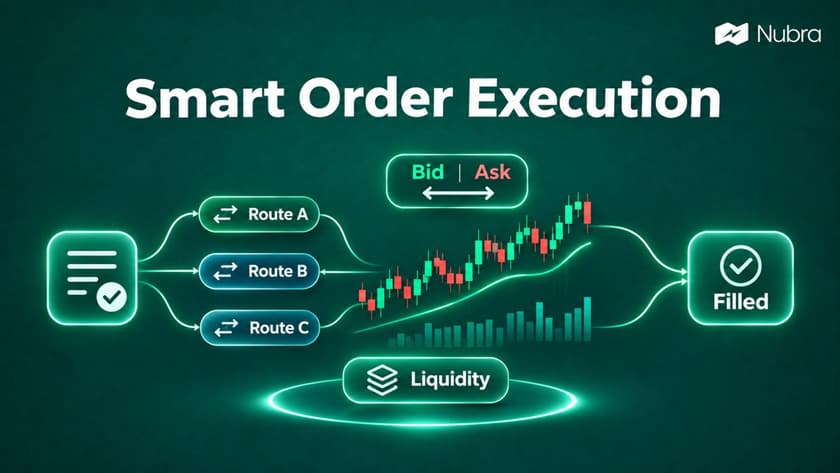
Smart order execution brings these decisions together. It concerns how an order is handled, from choosing instructions to checking the final fill. Smart order routing, or SOR, addresses one part of that process: deciding where an eligible order should go.
In this guide, we explain that distinction, work through a price example and explore the checks that matter for Indian equity and options traders.
What is Smart Order Execution?
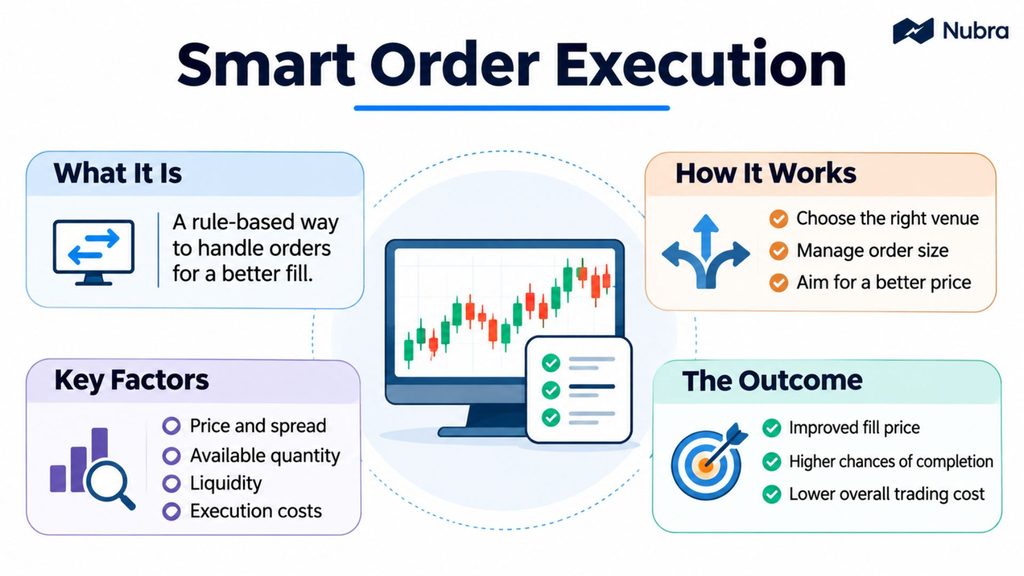
Smart order execution is a broad term for handling orders with rules that consider price, quantity, timing and available liquidity. Depending on the system, those rules may help select a trading venue, release smaller orders or manage an unfilled balance.
The aim is to manage the trade-off between the price we accept and the chance of completing our order. There is no single execution method that delivers the right result in every market.
Consider a purchase with a strict price limit. We may protect our maximum buying price, but the order can remain unfilled. If we prioritise an immediate fill instead, we may have to accept a different price. Execution quality depends on the objective we set before submitting the order.
“Smart” also describes different products across brokers. We need to check the actual feature rules rather than assume that every smart order compares exchanges or automatically changes its price.
How Does Smart Order Routing Fit in?
Smart order routing compares supported trading venues and selects a destination using factors such as price, available quantity and execution costs. Some systems can divide an eligible order between venues; others select one exchange for the order.
We can distinguish three related ideas:
- Routing: Where should the order be sent?
- Execution scheduling: Should the quantity be submitted together or released over time?
- Trade logic: What conditions should trigger an order in the first place?
These functions can work together, but they are not interchangeable. An automated trading strategy may generate an order and then use a router to send it. A time-based execution method may release portions on one exchange without comparing venues at all.
For Indian traders, exchange comparison is relevant only where the instrument and broker support it. We should not assume that similarly named derivatives on different exchanges are interchangeable contracts. The underlying, expiry, contract specifications and venue all matter.
What Affects the Price We Actually Receive?
Bid, Ask and the Spread
The bid is the price a buyer is currently offering. The ask is the price a seller is currently seeking. Their difference is the bid–ask spread.
If a share has a bid of ₹249.90 and an ask of ₹250.10, the spread is ₹0.20. A displayed last traded price of ₹250 does not mean that a new buy order can fill at ₹250. That figure records a previous trade.
For an options contract, this distinction can be particularly noticeable when the spread is wide. We need to examine the available quote rather than treat the last premium as an executable price.
Quantity at Each Price
Market depth shows the quantities offered at different price levels. A favourable quote for 20 shares may not be enough for an order of 500 shares.
Liquidity also changes. Other traders can consume the displayed quantity, and orders can be withdrawn before ours arrives. A snapshot helps us understand the market at that moment; it does not reserve the quote.
Open interest and trading volume provide useful context, but neither establishes how much can be bought or sold at our intended price. Our guide to open interest versus volume explains what these measures represent.
Slippage and Market Impact
Slippage is the difference between our expected price and the actual fill price. It can be favourable or unfavourable. Market impact is the price movement associated with the trading activity itself, including an order consuming available liquidity.
We should separate these effects from brokerage and other charges. A small difference in the quoted price can matter across a large quantity, while charges can change the overall cost of the transaction.
A Worked Example of Execution Price
Suppose we want to buy 400 shares of an illustrative company. The following offers are available at a particular instant:
- Exchange A: 150 shares at ₹500; the next 250 shares at ₹500.40.
- Exchange B: 400 shares at ₹500.15.
Sending the full quantity to Exchange A would cost ₹2,00,100 before charges. The average price would be ₹500.25.
Sending the full quantity to Exchange B would cost ₹2,00,060 before charges, giving an average of ₹500.15. Although Exchange A displays the lowest initial ask, Exchange B offers the lower average for the full quantity in this snapshot.
If a supported router could divide the order, buying 150 shares on A at ₹500 and 250 on B at ₹500.15 would cost ₹2,00,037.50. The average would be about ₹500.09 before charges.
This is arithmetic using assumed, unchanged quotes, not a forecast or a promise of achievable savings. In a live market, liquidity can move, charges can differ and the router may not support splitting. The useful lesson is that the top quote alone does not establish the cost of the entire order.
How an Execution Process Works
A practical execution process has several stages. We need to understand the instructions and the result, even when software handles the steps in between.
- Define the order. Confirm the instrument, exchange where relevant, buy or sell direction, quantity and permitted price. For options, check the strike, expiry and call or put designation.
- Assess the market. Examine the spread and available depth. For an eligible routing service, the system compares the venues it supports.
- Apply the instructions. The order type, validity and any supported execution settings determine what the system can do. A price restriction can prevent a fill when available quotes fall outside it.
- Submit and monitor. An order acknowledgement confirms receipt or acceptance at a particular stage. We still need execution reports to establish whether any quantity traded.
- Reconcile the result. Check filled quantity, average price and the remaining balance. A cancellation request also needs confirmation; it does not reverse a quantity that has already traded.
If an order appears delayed, submitting another immediately can create duplicate exposure. We first need to establish the status of the original order and any cancellation request.
Which Execution Approaches Might We Encounter?
Price- and Cost-Aware Routing
compares executable prices and, where included in the system, transaction costs. The lowest headline quote may be less attractive once quantity and costs are considered.
Liquidity-Aware Routing
considers where sufficient quantity is available. It may help address a larger order, but displayed depth can disappear before execution.
Time-Based Execution
releases portions across a chosen period. This can spread trading activity, while leaving the unfinished quantity exposed to later price changes.
Volume-Based Execution
adjusts trading activity in relation to market volume. VWAP, the volume-weighted average price, is a benchmark that combines traded prices with their quantities. A VWAP-oriented method aims towards a benchmark; it cannot promise to match it.
These are execution concepts, not a list of features available on every platform. Dark-pool routing, often discussed in international articles, should not be assumed to be an available route for an Indian retail order.
How Do Market and Limit Orders Change the Trade-Off?
A market order seeks execution against available opposing orders. The final price depends on the liquidity available when it reaches the market, subject to applicable protections and restrictions. It is not a promise of completion at the displayed price.
A limit order sets a maximum buying price or minimum selling price. It controls the acceptable price, but the order may receive no fill or only a partial fill. Even when a trade occurs at our limit, orders ahead in the queue may receive the available quantity first.
We therefore need to ask what matters for the particular order: price certainty within a limit, urgency or completion of the full quantity. Tightening a limit can reduce execution opportunities; loosening it can increase the price we are willing to accept.
Order availability and validity differ by broker, instrument and segment. We should verify the current rules before relying on an instruction.
Why Options Execution Needs Extra Attention
A multi-leg options position depends on the fills across all its legs. A payoff model may assume particular premiums, but the combined entry price changes if actual fills differ.
Suppose an illustrative spread has an expected debit of ₹40 per unit. If the bought option fills ₹1.50 above the assumed premium and the sold option fills ₹1 below it, the actual debit becomes ₹42.50 before charges. Across an assumed quantity of 100 units, that difference adds ₹250 to the entry debit. Actual tradable quantities must follow the relevant contract lot size.
There is also a timing risk. If one leg fills while another remains pending, the position temporarily differs from the intended spread. A basket submission should not be assumed to guarantee simultaneous or complete execution of every leg.
We can explore the planning concepts in Nubra’s option strategy builder guide. When assessing a specific contract, the option chain guide explains how to read the surrounding data. Neither a modelled payoff nor high open interest guarantees a live fill.
How Do We Review Execution Quality?
We need a defined reference point to make a useful comparison. That might be the available quote when the order was submitted or another benchmark appropriate to the execution objective.
Our review can record:
- The expected price and the time at which it was observed.
- The requested quantity and the quantity actually filled.
- The average fill price and time taken to complete the order.
- Charges, rejected quantities and any unfilled balance.
- Changes in the spread or market conditions during execution.
A fast first fill does not necessarily mean the entire order completed quickly. Equally, an attractive average on a small filled portion can hide a substantial pending balance.
For intraday trading, we also need to reconcile open positions before the applicable cut-off. Cancelling pending orders does not close quantities already executed. Where fills occur on multiple exchanges, we should check the broker’s position and square-off rules rather than assume that one closing instruction handles every quantity.
Where Nubra’s Tools Help With Preparation
We can use the Nubra Option Chain to examine contract premiums, volume, open interest and Greeks. These inputs help us understand an options position; they do not establish the quantity available at our intended execution price.
The Nubra Strategy Builder supports constructing options positions and examining payoff scenarios. We still need to compare model assumptions with actual fills and charges.
Nubra Charts provide price context for the setup and timeframe we are studying. Historical price movement cannot confirm a future execution price. The Strategy Builder and Charts may require sign-in.
Together, these tools support analysis and preparation. They should not be treated as evidence of automatic venue selection, guaranteed fills or a particular execution speed. Before using any execution feature, we need to confirm its current availability and rules.
FAQs
Is Smart Order Execution the Same as Smart Order Routing?
No. We use smart order execution as a broader description of order handling. Smart order routing concerns the destination of an eligible order. Scheduling, order instructions and fill monitoring are other parts of execution.
Can Smart Order Routing Guarantee a Better Price?
No. A router can compare supported venues using available information, but quotes and quantities may change before an order arrives. Actual results also depend on the order instructions and routing design.
Does a Limit Order Remove Execution Risk?
No. A limit controls the acceptable price, but we may receive a partial fill or no fill. A pending order can also fill later while it remains active, changing our exposure.
Does High Open Interest Mean an Option is Easy to Trade?
Not necessarily. Open interest measures outstanding contracts. We still need to examine the current bid, ask and available quantities. A large open-interest figure does not guarantee a narrow spread or sufficient depth.
Why Can a Multi-Leg Strategy Fill at a Different Price From its Model?
A model uses assumed premiums. Actual premiums can change before each leg fills, and some legs may remain unfilled. We need to reconcile the combined execution price and charges against the original assumptions.
Do Nubra’s Analysis Tools Guarantee Order Execution?
No. We can use the Option Chain, Strategy Builder and Charts for analysis and preparation. Execution depends on available liquidity, market conditions, order instructions and the supported trading service.
Disclaimer: The information provided in this blog is for educational and informational purposes only and should not be construed as investment advice, financial advice, or a recommendation to buy, sell, or hold any securities or financial products. Investments in the securities market are subject to market risks. Please read all related documents carefully before investing. Readers should conduct their own research and consult a SEBI-registered investment adviser or other qualified financial professional before making any investment decisions. Past performance is not indicative of future results.