An option premium is not one clean number. It is a price being pulled by several forces at the same time: the underlying price, time left to expiry, implied volatility, strike selection, interest rates, and market expectations. The Greeks help separate those forces. Delta shows how much the option may respond when the underlying moves. […]
Getting to Know the Greeks: Delta, Gamma, Theta, Vega, and Rho in Options Trading
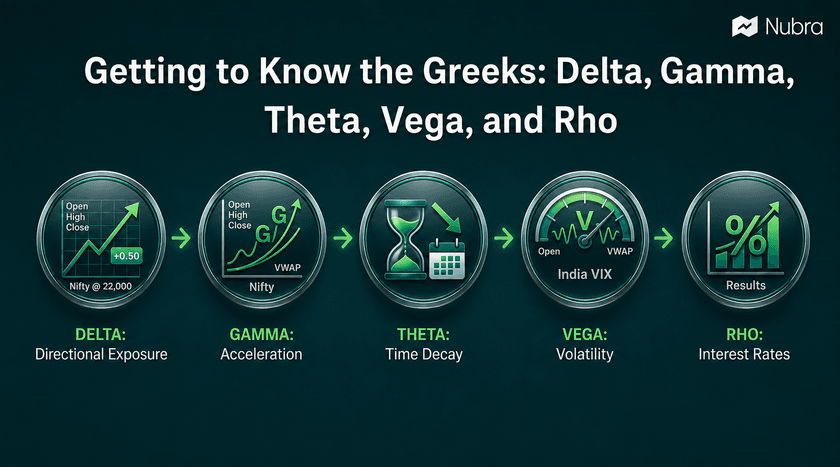
An option premium is not one clean number. It is a price being pulled by several forces at the same time: the underlying price, time left to expiry, implied volatility, strike selection, interest rates, and market expectations.
The Greeks help separate those forces.
Delta shows how much the option may respond when the underlying moves. Gamma shows how quickly that delta can change. Theta shows how much time decay is working for or against a position. Vega shows how sensitive the option is to implied volatility. Rho shows how interest-rate changes can affect the option, though it usually matters less for short-dated index and stock options.
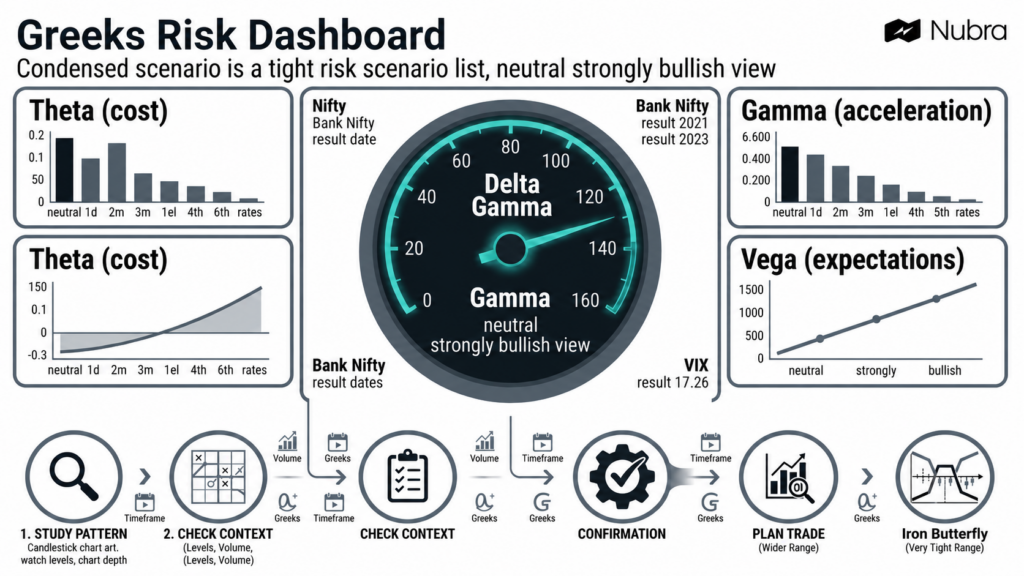
Greeks are best treated as a risk dashboard, not as a prediction engine. They do not tell a trader where Nifty, Bank Nifty, or a stock will go next. They show how an option position may behave if price, time, volatility, or rates change. That distinction matters because options can gain or lose value even when the underlying does not move as expected.
This guide explains the main Greeks in plain language, with examples that fit active options trading in India. It is educational and should not be treated as investment advice. Trading involves market risk, and every strategy depends on market conditions, execution, position size, and user decisions.
What Moves an Option Premium?
Before reading the Greeks, it helps to understand what actually moves an option premium.
An option is not priced only from the current spot price. A Nifty call, a Bank Nifty put, or a stock option premium reflects several inputs:
| Pricing factor | What it means | Greek most closely linked |
|---|---|---|
| Underlying price | Movement in the index or stock | Delta and gamma |
| Strike price | Whether the option is ITM, ATM, or OTM | Delta and gamma |
| Time to expiry | How much time the option has left | Theta |
| Implied volatility | Market expectation of future movement | Vega |
| Interest rates | Cost-of-carry and discounting effect | Rho |
| Dividends, where relevant | Expected dividend impact on stock options | Usually model input, not a daily focus |
For example, a call buyer may still lose money even if the underlying moves up, if implied volatility falls sharply or time decay eats into the premium. An option seller may still face pressure even when the underlying stays range-bound, if volatility jumps or gamma rises near expiry. Greeks help traders understand these moving parts instead of looking only at the premium.
Greeks at a Glance
| Greek | What it helps traders understand | Simple reading |
|---|---|---|
| Delta | Directional exposure | How much the option may move when the underlying moves |
| Gamma | Speed of delta change | How quickly directional exposure can change |
| Theta | Time decay | How much value the option may lose as time passes |
| Vega | Volatility exposure | How much the option may react to changes in implied volatility |
| Rho | Interest-rate exposure | How much the option may react to rate changes |
The Greeks are usually model-based estimates. They are useful, but they are not guarantees. In fast markets, bid-ask spreads, liquidity, slippage, sudden volatility changes, and execution timing can make the real outcome different from the neat theoretical number.
Delta: The First Greek to Check for Direction
Delta measures how much an option’s premium may change for a one-point move in the underlying.
If a Nifty call has a delta of 0.50, it can be read this way: for a 1-point move in Nifty, the option premium may move by about 0.50 points, all else being equal. If Nifty moves up 100 points, a simple delta estimate would suggest the call premium may rise by about 50 points. In reality, gamma, theta, vega, and liquidity can change the result, but delta gives the first directional estimate.
For calls, delta is usually positive. For puts, delta is usually negative.
| Option type | Typical delta behavior |
|---|---|
| Call option | Premium usually rises when the underlying rises |
| Put option | Premium usually rises when the underlying falls |
| ATM option | Delta often sits near 0.50 for calls and -0.50 for puts |
| Deep ITM option | Delta is closer to 1 for calls or -1 for puts |
| Deep OTM option | Delta is closer to 0 |
Delta is also used as a rough probability-style signal, with caution. A 0.30 delta call is often interpreted as having roughly a 30% chance of expiring in the money, but it should not be treated as an exact probability. It changes as price, volatility, and time change.
The practical question is simple: how much directional exposure does the position create?
If a trader buys a high-delta option, the position is closer to trading the underlying itself, but the premium is usually higher. If the trader buys a low-delta OTM option, the premium may look cheaper, but the trade may need a larger move or a volatility expansion to work. This is where many traders get trapped. A cheap option is not automatically a better option; it may simply have a lower chance of responding meaningfully unless the underlying moves enough.
For a trader using Nubra or any options workflow, delta is useful because it turns a vague market view into measurable exposure. Instead of only saying, “this is a bullish view,” the better question is, “how much bullish exposure does this position carry if Nifty moves 100 points?”
Gamma: The Greek That Changes the Shape of the Trade
Gamma measures how quickly delta changes when the underlying moves.
If delta is the current speed of an option, gamma is the acceleration. A call with 0.50 delta and 0.04 gamma may move to roughly 0.54 delta after a 1-point move in the underlying, all else being equal. For index options, traders often scale this idea to larger moves, but the principle is the same: gamma shows whether directional exposure can change quickly.
Gamma is usually highest for at-the-money options and near-expiry options. That is why expiry-day option behavior can feel sharp. A position that looked manageable when the underlying was quiet can become much more sensitive after a quick move.
Gamma deserves close attention when the position is near the strike, near expiry, or built with short options.
For a long option buyer, gamma can help when the underlying moves in the expected direction because the option’s delta may increase. But the same high-gamma setup can also hurt if the move reverses. For an option seller, short gamma can be uncomfortable because losses can accelerate when the underlying moves sharply against the position.
This is why delta should not be read alone. A 0.40 delta option with high gamma is not the same as a 0.40 delta option with low gamma. The first one can change character quickly. The second may behave more steadily, especially if there is more time to expiry or the strike is farther from ATM.
In practical terms, gamma answers this question: will this position stay roughly similar if the market moves, or can its risk profile change fast?
Theta: The Cost of Waiting
Theta measures time decay. It estimates how much value an option may lose as time passes, assuming other factors stay constant.
If an option has theta of -5, it can be read this way: the option may lose about 5 points of premium over a day because of time decay, all else being equal. Long options usually have negative theta because the buyer is paying for time value. Short options usually have positive theta because the seller may benefit as time value decays.
Theta should not be read as a free lunch. For sellers, theta may look attractive, but price movement or volatility expansion can overwhelm the decay collected. For buyers, theta is the daily cost of being wrong, early, or stuck in a sideways market.
Theta becomes especially important near expiry. In weekly options, time decay can feel slow at first and then much faster as expiry approaches. At-the-money options often carry meaningful time value, so they can see stronger decay if the underlying does not move enough.
Here is a practical way to think about it:
| Position type | Theta effect |
|---|---|
| Long call or long put | Time decay usually works against the buyer |
| Short call or short put | Time decay usually works for the seller |
| ATM option near expiry | Theta can become very important |
| Deep ITM option | More value is intrinsic, so theta may be less dominant |
| Deep OTM option | Premium can decay quickly if the expected move does not happen |
For example, if a trader buys a Bank Nifty weekly call expecting a sharp move, the move needs to happen soon enough. If the index stays flat for two sessions, the option may lose premium even if the broad view is not completely wrong. The timing of the view matters as much as the direction.
This is why a strategy builder or simulator view can be useful in an options workflow. It helps traders see whether the trade depends mostly on direction, time decay, volatility, or a combination of all three. The point is not to remove risk; the point is to understand what kind of risk the position carries.
Vega: The Volatility Greek
Vega measures how much an option’s premium may change when implied volatility changes by one percentage point.
If an option has vega of 0.20, and implied volatility rises from 15% to 16%, the option premium may rise by about 0.20 points, all else being equal. If implied volatility falls, the premium may fall by a similar amount.
Vega matters because options are not only about movement. They are also about expected movement.
This is why premiums can rise before major events, results, policy announcements, or periods of market uncertainty. Traders may be willing to pay more for optionality because they expect a larger move. After the event, implied volatility may fall. That fall can hurt long-option buyers even if the underlying moves somewhat in the expected direction.
Vega is the “expectation” Greek. If the market expects a storm, option premiums may become expensive. If the storm passes or the expected move does not arrive, volatility can compress.
In Indian markets, this matters around events such as budget sessions, RBI policy days, major global cues, election-related uncertainty, earnings for stock options, or sudden India VIX spikes. A trader looking only at delta may wonder why a call did not gain as much as expected after the underlying moved up. Vega may be part of the answer if implied volatility dropped.
Vega is usually higher when there is more time to expiry and when options are closer to ATM. Near expiry, vega often becomes less dominant because there is less time for volatility to matter. But during sharp event-driven markets, volatility can still affect premiums meaningfully.
The main vega question is: is the position buying volatility when it is already expensive, or selling volatility when it can still expand?
That question does not decide the trade by itself, but it keeps traders from treating every premium as equally attractive.
Rho: The Greek That Matters More in Longer-Dated Options
Rho measures how much an option’s value may change when interest rates change.
For calls, rho is generally positive. Higher interest rates can slightly increase call values. For puts, rho is generally negative. Higher rates can slightly reduce put values. The effect tends to matter more for long-dated options and less for short-dated weekly contracts.
In day-to-day index options trading, rho is rarely the lead Greek. Delta, gamma, theta, and vega usually matter more. But rho should not be ignored completely. If a trader is studying longer-dated options, LEAPS-style structures in markets where they are relevant, or rate-sensitive periods, rho deserves more attention.
In India, a sudden rate decision can affect options in two ways. The direct rho effect may be small for short-dated options, but the market reaction to the rate decision can move the underlying and implied volatility. That means delta and vega may dominate the actual premium change, even though the event itself is about rates.
The working rule is simple: rho is usually not the first Greek to check for short-term trades, but it belongs in the full pricing picture.
How the Greeks Work Together
The most useful part of Greeks is not memorizing them one by one. It is learning how they interact.
Suppose a trader buys an at-the-money Nifty call before a major event. The position may have positive delta, positive gamma, negative theta, and positive vega.
That means:
| If this happens | Possible Greek effect |
|---|---|
| Nifty rises | Delta helps the call |
| Nifty rises quickly | Gamma may increase the call’s sensitivity |
| Time passes without movement | Theta hurts the call |
| Implied volatility rises | Vega helps the call |
| Implied volatility falls after the event | Vega hurts the call |
The trade is not simply “bullish.” It is bullish, long volatility, long gamma, and paying time decay. Without understanding that combination, the outcome can be misread.
Now suppose a trader sells an out-of-the-money Bank Nifty call. The position may have negative delta, negative gamma, positive theta, and negative vega.
That means the position may benefit from time decay and falling volatility, but it may be hurt by a sharp upward move or a volatility spike. If the position is close to expiry, gamma risk can rise quickly. The premium collected may look attractive, but the risk profile can change fast.
This is why Greeks are most useful in combinations:
| Strategy behavior | Greeks to watch closely |
|---|---|
| Directional long option | Delta, theta, vega |
| Short option income trade | Gamma, theta, vega |
| Debit spread | Delta, theta, max risk, max reward |
| Credit spread | Gamma, theta, defined risk |
| Long straddle or strangle | Vega, gamma, theta |
| Iron condor | Gamma, theta, vega, range risk |
| Delta-neutral adjustment | Net delta, gamma, vega |
The exact numbers change with the option model, market data, and trading platform. The thinking remains the same: what has to go right for the position, and what can go wrong even if the broad market view is reasonable?
How to Use Greeks in a Practical Options Workflow
When reviewing an options idea, the goal is not to find the “best” Greek. The goal is to move through a workflow that explains the position clearly.
First, define the market view. Is the position being studied for a directional move, a range-bound view, a volatility event, or a hedge?
Then check delta. This shows how much directional exposure the position carries. If the idea is directional but the option has very low delta, the trade may need a large move or volatility expansion.
Next, check gamma. If the option is near ATM or close to expiry, the key question is how quickly the position can change. This is especially important for short options because short gamma can become uncomfortable in fast markets.
After that, check theta. For option buyers, this shows how much time value is being paid for. For option sellers, it helps frame whether the theta collected is worth the price and volatility risk being accepted.
Then check vega. Before events, the question is whether implied volatility is already elevated. After events, the risk is volatility crush. A correct directional view can still disappoint if volatility falls sharply.
Finally, check rho when the option is longer-dated or rate sensitivity is relevant. For weekly index options, rho usually stays in the background.
This kind of workflow is where Nubra’s educational and options-trading focus can fit naturally. A trader does not need Greeks as isolated textbook definitions. Greeks are more useful next to option-chain data, payoff thinking, scenario analysis, and risk checks. When the workflow keeps these pieces together, traders can make more disciplined decisions about what they are actually exposed to.
The Bottom Line
The Greeks make options easier to understand because they break the premium into measurable risks. Delta helps read direction. Gamma helps read acceleration. Theta helps read time decay. Vega helps read volatility. Rho helps read interest-rate sensitivity.
But Greeks should not become a shortcut to confidence. They are a discipline. They remind traders that an option position can lose money for more than one reason: the underlying can move against the position, time can pass, volatility can fall, liquidity can widen, or the position can become more sensitive near expiry.
For active traders, especially in Nifty, Bank Nifty, and stock options, that is the real value of Greeks. They turn a trade from a simple opinion into a structured risk view.
FAQs
What are option Greeks?
Option Greeks are model-based measures that estimate how an option’s price may respond to changes in the underlying price, time, implied volatility, and interest rates. The main Greeks are delta, gamma, theta, vega, and rho.
Which Greek is most important?
Delta is usually checked first because it shows directional exposure, but no single Greek is enough. For short-dated options, gamma and theta can become very important. For event-driven trades, vega can dominate the outcome.
What does delta mean in options?
Delta estimates how much an option premium may change for a one-point move in the underlying. A call with 0.50 delta may gain about 0.50 points for a one-point rise in the underlying, assuming other factors stay constant.
What does gamma show?
Gamma shows how quickly delta may change. High gamma means the option’s directional exposure can change quickly, especially near ATM strikes and close to expiry.
Why is theta important for option buyers?
Theta is important because long options lose time value as expiry approaches. If a trader buys an option and the underlying does not move enough quickly enough, theta can reduce the premium even if the market view is not completely wrong.
Why does vega matter before market events?
Vega matters because implied volatility often rises before major events and can fall after the event. A trader buying options before an event may be buying expensive volatility, and a volatility drop can reduce premium after the event.
Is rho important for weekly options?
Rho is usually less important for short-dated weekly options than delta, gamma, theta, and vega. It matters more for longer-dated options or when interest rates are changing significantly.
Can Greeks predict profits?
No. Greeks do not predict profits. They estimate how an option’s theoretical value may respond to certain changes. Actual outcomes depend on market movement, volatility, liquidity, execution, position sizing, and risk management.
How should traders read Greeks on an option chain?
Read Greeks together. Delta shows directional exposure, gamma shows how that exposure may change, theta shows time decay, vega shows volatility exposure, and rho shows rate sensitivity. The combined picture is more useful than any single number.
Disclaimer: The information provided in this blog is for educational and informational purposes only and should not be construed as investment advice, financial advice, or a recommendation to buy, sell, or hold any securities or financial products. Investments in the securities market are subject to market risks. Please read all related documents carefully before investing. Readers should conduct their own research and consult a SEBI-registered investment adviser or other qualified financial professional before making any investment decisions. Past performance is not indicative of future results.
Published Jul 18, 2026