Automated trading platforms use software to monitor market data and submit or manage orders according to defined rules. We set the conditions; the system checks them and acts within the permissions and limits we provide. That sounds straightforward until we look at what “automated” covers. One platform may send alerts that require our approval. Another…
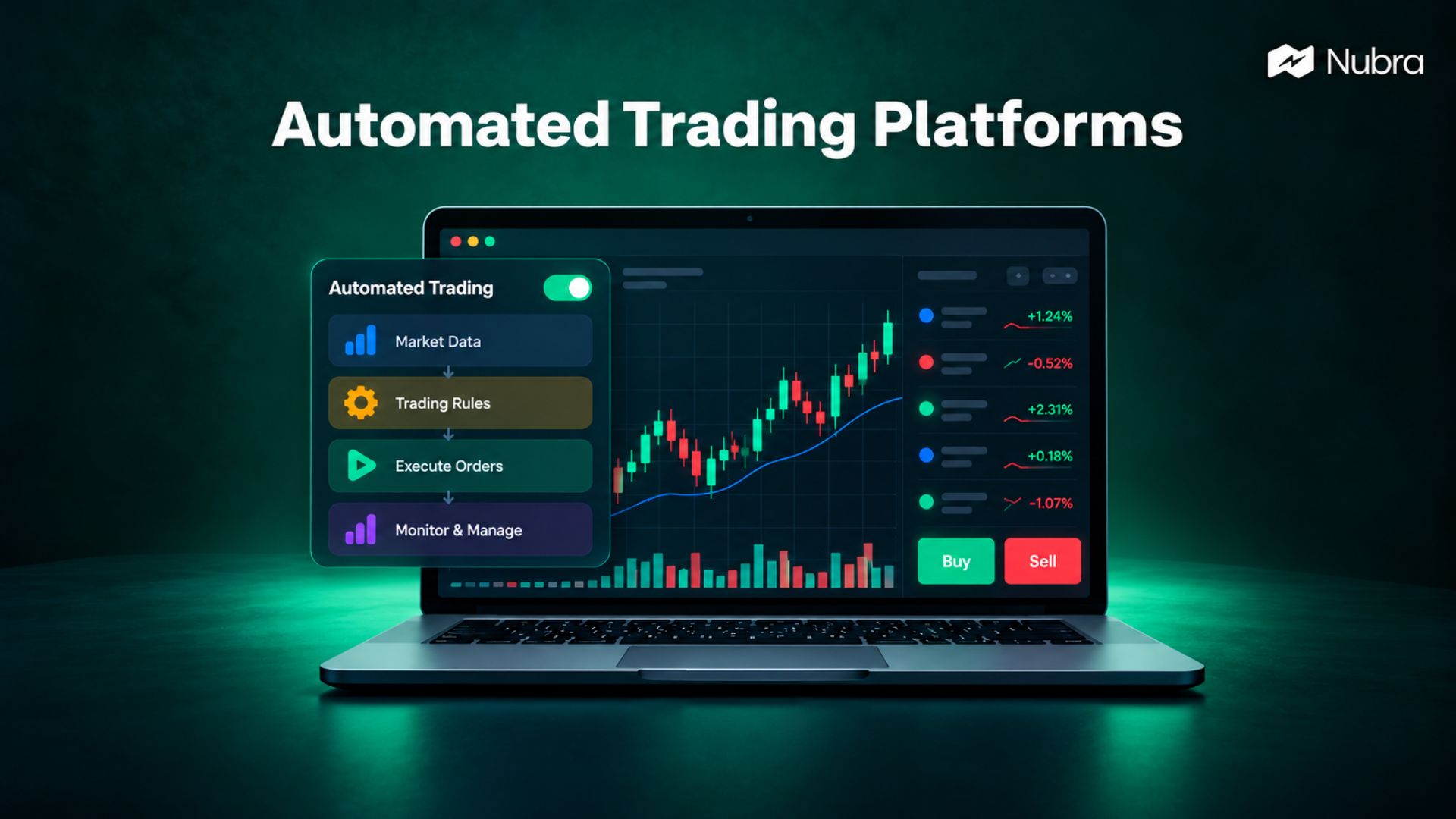
Automated trading platforms use software to monitor market data and submit or manage orders according to defined rules. We set the conditions; the system checks them and acts within the permissions and limits we provide.
That sounds straightforward until we look at what “automated” covers. One platform may send alerts that require our approval. Another may place orders through a broker connection. A third may help us build a strategy without running it automatically.
Before we compare features, we need to understand which part of our trading process we want to automate. In this guide, we’ll work through the different approaches, the checks that matter and where Nubra’s tools fit.
How Do Automated Trading Platforms Work?
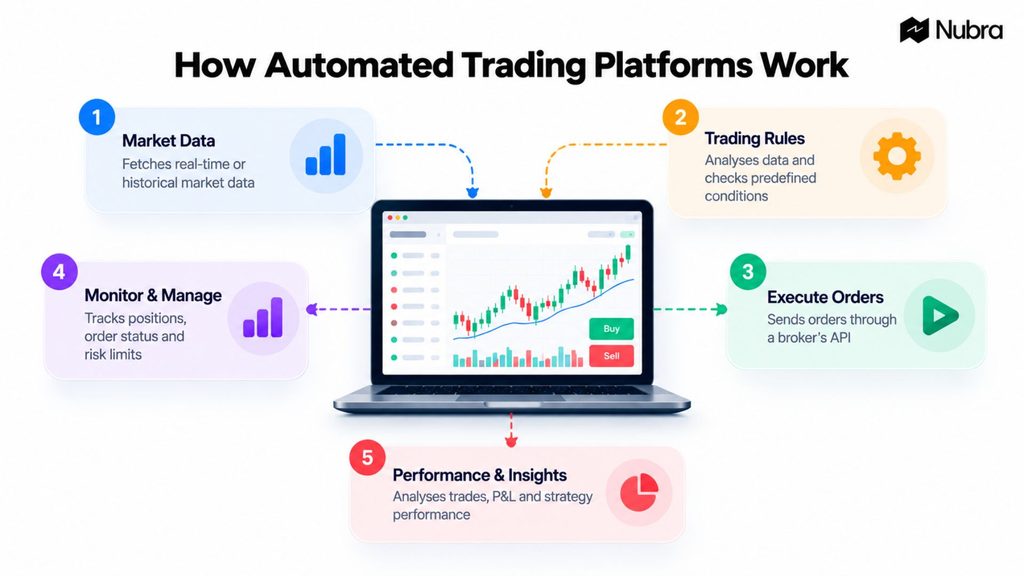
Most systems connect market data, trading rules, risk checks and order management. We remain responsible for deciding what those rules should do and when they should stop.
From Market Data to a Signal
A strategy starts with information such as prices, volume or time. For options, we may also study the underlying instrument, expiry, implied volatility and Greeks. Greeks describe how an option’s value responds to factors such as price, time and volatility.
Our rule needs a precise definition. “Enter when the market looks strong” leaves too much open to interpretation. “Check whether a completed five-minute candle closes above a specified level” gives software a condition it can evaluate.
Meeting that condition produces a signal. It does not mean a trade has happened.
From a Signal to an Order
Before submitting an order, the system should check the permitted instrument, quantity, available funds or margin, and existing exposure. We also need a rule that prevents the same signal from creating repeated entries.
An application programming interface, or API, lets software communicate with a broker’s systems. An order submitted through that connection may be accepted or rejected. An accepted order may remain pending or receive only a partial fill.
We therefore track the broker’s reported order status and actual positions. If a connection times out, sending the same request again without checking its status can create an unintended second order.
After the Trade
Automation continues with position monitoring, exit instructions and records of what happened. We need alerts for unusual behaviour and a way to pause new orders.
Our guide to automated trading systems explains how these stages fit together. The platform is part of the system; its reliability also depends on our rules, data and implementation.
Which Type of Automation Do We Need?
The useful distinction is how much of the process the software handles. Labels such as “AI-powered” tell us less than a clear explanation of who makes the decision and who submits the order.
Alerts and Assisted Trading
A scanner or charting tool can identify a condition and notify us. We review the information and decide whether to act.
This can suit a process where judgement remains important, but it is different from automatic execution. We need to know whether an alert is informational or connected to an order-placement mechanism.
Rules Built Through a Visual Interface
Some platforms let us define conditions through menus or visual blocks. This can reduce the amount of code we write, although it does not remove the need to understand the strategy.
We should check whether the available rules cover our entry, exit, position sizing and exceptions. A template that looks suitable may behave differently when an order is rejected or only partly filled.
Custom API-Based Systems
An API-based approach gives us more control over the logic and connections. It also brings development, hosting, security and maintenance responsibilities.
We need to manage authentication, data interruptions, order updates and recovery after a restart. Our basics of algorithmic trading guide introduces these building blocks before we move into implementation.
Copy trading is another arrangement: it follows a provider’s trading activity rather than simply running rules we designed. We should understand that difference before evaluating any platform’s automation claims.
What Should We Check Before Choosing a Platform?
A useful comparison starts with our intended process. A long feature list matters only when those features support the instruments, controls and connections we need.
Instrument and Broker Compatibility
We first confirm that the platform and connected account support our intended instruments and trading permissions. A global platform comparison may focus on products or market access that do not apply to an Indian account.
For options, contract details matter. The system must identify the correct underlying, strike, expiry and contract quantity. An expired identifier or incorrect quantity can undermine otherwise sound logic.
Data and Testing
We need to understand what data is available, how often it updates and whether historical records suit our rules. A strategy based on intraday movements needs data that can represent those movements.
We also check whether the platform provides testing tools or whether we must connect a separate testing environment. Historical data access and a complete backtesting engine are different capabilities.
Order Handling and Risk Controls
We look for a clear view of pending orders, partial fills, rejections and positions. For a multi-leg options strategy, we need to understand what happens if one leg trades while another does not.
Controls should address quantity, exposure and repeated signals. We also need a defined response to stale data, lost connectivity and unexpected positions. Stopping new orders does not automatically cancel pending orders or close existing exposure.
Costs, Security and Support
Our comparison should include relevant brokerage, transaction charges, data subscriptions, software, hosting and development costs. Small costs can accumulate when a strategy trades frequently.
We should understand account permissions, protect credentials and know how to revoke access. Support documentation should explain what happens during an outage and how we can review orders independently of our automation.
What Can Automation Improve, and What Remains Our Responsibility?
Automation can apply a written process consistently and reduce the repetitive work of checking conditions. It can also help us record signals and order events for later review.
However, it follows flawed instructions as readily as useful ones. A position-size error can be repeated across several trades before we notice it. Faster processing does not guarantee a favourable execution price.
We may reduce impulsive decisions at the point of entry, but judgement still shapes the system. Increasing size after losses or repeatedly changing rules can reintroduce the same behavioural problems through a different interface.
Market risk remains. Prices can gap, liquidity can deteriorate and stop-loss orders may execute beyond the intended level. Options add changing volatility, time decay and exposure across several legs.
For intraday processes, our guide to algorithmic and automated intraday trading explores how timing and monitoring affect system design. Automation changes how we carry out a plan; it does not establish that the plan has an advantage.
How We Test Before Considering Live Trading
Testing should examine both the trading idea and the software that carries it out. A promising historical result cannot tell us whether a system will recover correctly after a disconnection.
Write the Rules Before Testing
We start with the instrument, signal, entry window, quantity, exit conditions and circumstances that should prevent trading. We also define how the system handles an existing position.
Consider a hypothetical share-trading example: an entry at ₹500 with a planned exit at ₹490 gives a price difference of ₹10 per share. For 50 shares, the planned loss is ₹500 before costs and slippage. Slippage is the difference between the expected price and the execution price.
The actual loss can be larger. This example explains the arithmetic, not a recommended position size or trading setup. Our risk/reward ratio guide explains why planned downside and actual outcomes can differ.
Use Realistic Assumptions
We include charges, bid–ask spreads, delays and plausible execution prices. A backtest that assumes every signal trades at the displayed price may overstate what the process can achieve.
We should avoid using information that was unavailable when the historical decision would have been made. We also test on a separate period from the one used to develop the rules. Repeatedly adjusting settings until the past looks attractive can produce a system fitted to that particular sample.
Test Failures and Simulated Execution
We check what happens when data stops updating, an order is rejected or the application restarts. The recovered system should reconcile its records with the broker’s order and position information before acting again.
Where an appropriate simulation is available, we can observe signals and order handling without placing live trades. Simulated fills may differ from real execution, so this stage is a software and process check rather than proof of future results.
We also define the circumstances in which live operation would pause. Testing is more useful when we know which failures or deviations would require investigation.
What Should We Check in India?
For Indian markets, we need to confirm the current broker and exchange requirements for our intended automation arrangement. API access alone does not establish that every strategy or third-party connection is permitted for an account.
We should ask which authentication, access controls, approvals and operating requirements apply before deployment. Requirements can depend on how the system is built and provided, so a general article cannot replace the broker’s current instructions.
Trading hours also matter. Software may remain online outside a session, but that does not mean orders can execute continuously. We need to account for holidays, expiry changes and instrument-specific trading conditions.
These checks belong alongside the technical work. A system that runs correctly in a test environment still needs the appropriate account permissions and operating arrangements.
Where Nubra’s Tools Fit
Once we understand the process we need, we can assess the relevant tools individually. Analysis, strategy planning and automated execution have connected but different roles.
Option Chain: Examine the Contracts
Our Nubra Option Chain displays strike-level information such as prices, open interest, volume, implied volatility and Greeks.
We can use this information to examine contracts and understand the inputs behind an options idea. Open interest measures outstanding contracts; it is not a prediction that price will move in a particular direction.
Strategy Builder: Examine the Combined Position
Our Nubra Strategy Builder supports building multi-leg options strategies and examining payoff scenarios. Access may require signing in.
We use the combined view to understand how the legs relate to one another. A modelled payoff depends on its assumptions; it does not guarantee a live result. Building a strategy is also different from specifying an automated deployment process.
Charts: Review Price Context
Our Nubra Charts in the trading terminal provide a place to review charts and the trading context. Access may require signing in.
We can use charts to make a proposed rule more precise, including its timeframe and confirmation condition. Chart analysis alone should not be confused with a running algorithm.
APIs and Conditional Orders: Check the Execution Method
For custom development, our Nubra API guides cover data and trading-related implementation. Our homepage also describes Flexi Orders with predefined entry, exit and trigger conditions.
Before connecting external software, we should review the Nubra integration documentation. Supported integrations and custom-built connections have different setup requirements. We need to verify the current method rather than assume that every charting or strategy tool connects automatically.
The next step is to match each tool to a clearly defined task, then check its current availability and limitations before using it with live orders.
FAQs
What Is an Automated Trading Platform?
It is software that monitors conditions and submits or manages orders according to rules. We need to check whether a particular product executes orders, sends alerts or only supports analysis.
Do We Need Coding Skills for Automated Trading?
Not for every approach. Visual tools may let us configure supported rules without writing code. Custom API systems require programming and maintenance. Both approaches still require us to understand the logic and risks.
Are Automated Trading Platforms Suitable for Beginners?
They can introduce additional complexity. Before considering live automation, we need to understand instruments, orders, costs and possible losses. Templates and a simple interface do not make a strategy suitable for everyone.
Can Automated Trading Guarantee Profits?
No. Results depend on the strategy, market conditions, costs, execution and system behaviour. Backtests and simulations do not establish future profitability, and automation can produce losses.
Is a Strategy Builder the Same as an Automated Trading System?
No. A strategy builder helps us construct and analyse a position. Automated trading additionally needs defined execution logic, a supported order connection, risk checks and ongoing monitoring.
Will Automated Trading Continue When Our Computer Is Off?
That depends on where the logic runs. Locally hosted software generally needs the computer and connection to remain available. Broker-held conditional orders or hosted systems may operate differently; we should verify the specific arrangement.
Disclaimer: The information provided in this blog is for educational and informational purposes only and should not be construed as investment advice, financial advice, or a recommendation to buy, sell, or hold any securities or financial products. Investments in the securities market are subject to market risks. Please read all related documents carefully before investing. Readers should conduct their own research and consult a SEBI-registered investment adviser or other qualified financial professional before making any investment decisions. Past performance is not indicative of future results.