To start algorithmic trading, we need a clear trading rule, suitable market data, a way to test the rule and a broker-supported route for execution. We then test the system with simulated orders before considering a small, closely monitored live deployment. Writing code is only part of the process. We also need to know what…
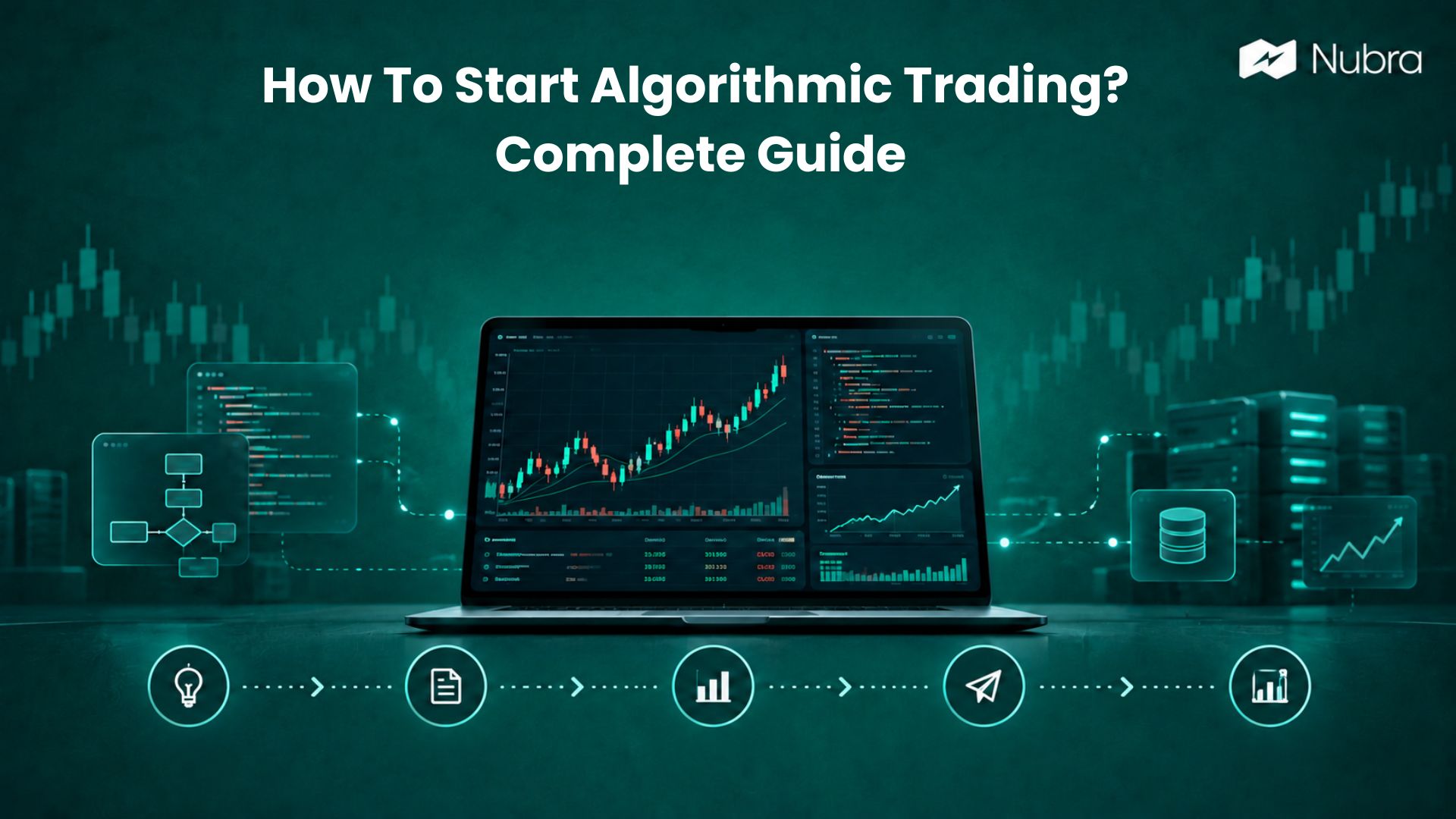
To start algorithmic trading, we need a clear trading rule, suitable market data, a way to test the rule and a broker-supported route for execution. We then test the system with simulated orders before considering a small, closely monitored live deployment.
Writing code is only part of the process. We also need to know what happens when prices move sharply, an order is rejected or our connection fails. This guide takes us through those decisions, from the first idea to ongoing monitoring.
What Is Algorithmic Trading?
Algorithmic trading uses software to generate and execute orders according to predefined rules. Those rules can depend on price, time, volume or other measurable conditions.
For example, we might test a rule that generates a signal when a short-term moving average crosses above a longer-term average. We would also define the exit, quantity and conditions that prevent another entry. This is an educational example, not a strategy recommendation.
Automation can make execution more consistent with our instructions. It cannot tell us whether those instructions have a lasting advantage. A poorly designed rule can repeat mistakes just as consistently.
What Do We Need Before We Begin?
We need an understanding of our chosen market, dependable data, a testing environment and access to a broker that supports the intended automation. We also need time to review results and handle problems during trading hours.
Our budget should cover more than trading capital. Data subscriptions, software, hosting, brokerage and other charges can affect whether a strategy is viable. We should calculate these costs before choosing an implementation.
There is no single starting capital figure that suits every system. Instrument prices, contract sizes, margin requirements and potential losses all matter. An amount that covers an order may still leave too little room for adverse moves.
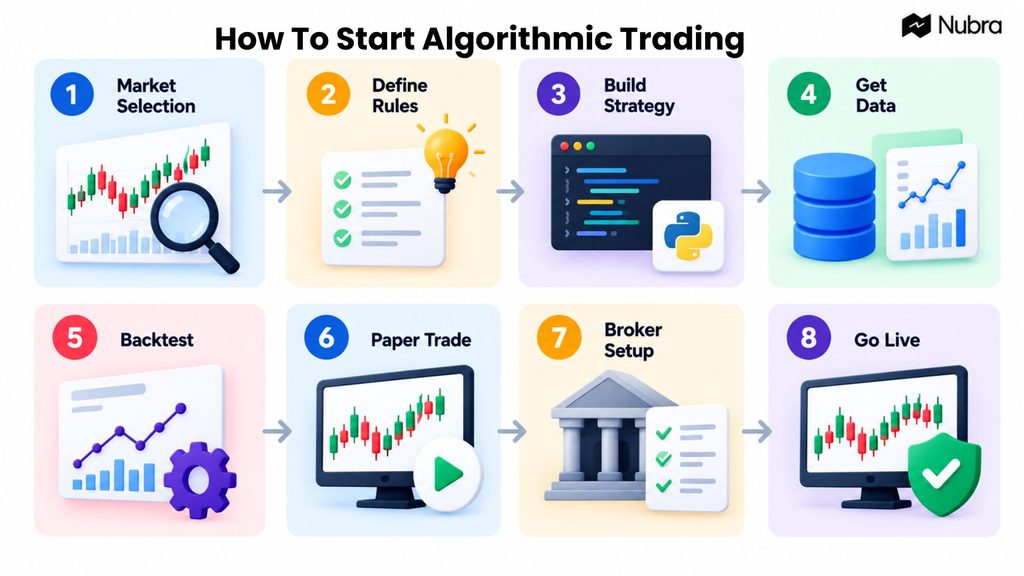
How to Start Algorithmic Trading: Eight Steps
1. Understand the Market We Want to Trade
We should begin with one instrument group and understand its trading hours, order types, liquidity and settlement requirements. For futures and options, contract expiry, lot size and margin requirements need particular attention.
Options introduce additional variables. A correct view on the underlying price does not necessarily produce a profitable option trade because volatility and time decay also affect the premium.
Before automating an options idea, we can revisit Nubra’s guide to reading an option chain. Understanding the data helps us decide what our rules should measure, rather than adding indicators without a clear purpose.
2. Turn the Idea Into Precise Rules
A trading idea becomes testable when two people can read it and reach the same decision from the same data. “Buy when the trend looks strong” leaves too much room for interpretation.
We need to specify:
- The instrument and timeframe.
- The exact entry and exit conditions.
- Position size and maximum total exposure.
- Trading hours and conditions for avoiding new entries.
- What happens after a rejected order, data interruption or loss limit.
For our moving-average example, we would decide whether a signal requires a completed candle. Using an unfinished candle in live trading while testing only completed candles changes the strategy.
We should also write down why the rule might work and when it might fail. This gives us something to investigate beyond an attractive profit figure.
3. Choose a Coding or No-Code Approach
With a coded approach, we build the strategy logic and connect it to supported data and order interfaces. Python is one option for research and implementation; the right choice depends on our skills and the broker’s documentation.
A no-code platform can let us express supported rules through a visual interface. We still need to understand its limitations, including available conditions, position handling and how it deals with errors.
Neither approach removes the need for testing. We should be able to explain every entry and exit before allowing software to act on our account. Nubra’s explanation of what API trading means helps separate the connection to a broker from the strategy that generates instructions.
4. Prepare Suitable Historical Data
Our data must match the strategy. Daily prices cannot show the order of price movements within a five-minute interval. An options strategy may require historical contracts and quotes that a simple underlying-price series does not provide.
We should check timestamps, missing observations, duplicate records and corporate actions where relevant. We must also avoid using information that would not have been available when a trade decision was made. This is called look-ahead bias.
Another trap is testing only stocks that exist today. Excluding companies that disappeared can make historical results look stronger than they were. Keeping a record of data sources and cleaning decisions makes later checks easier.
5. Backtest With Realistic Assumptions
Backtesting applies our rules to historical data. It helps us examine how the strategy might have behaved under stated assumptions; it does not prove what will happen next.
We should include brokerage, applicable charges, bid–ask spreads and slippage. Slippage is the difference between an expected execution price and the price actually obtained.
Suppose a hypothetical test shows ₹2,000 before costs across 100 completed trades. If the assumed total cost averages ₹25 per completed trade, costs reach ₹2,500. The apparent gain becomes a ₹500 loss. These figures illustrate the calculation, not actual Nubra charges.
We should review drawdown—the fall from a previous peak—as well as total returns, losing streaks and exposure. A high win rate alone can hide occasional large losses.
We can develop the rule on one period and evaluate it on a separate, untouched period. Repeatedly changing settings until every historical period looks good risks overfitting: designing a system around past noise rather than a repeatable relationship.
6. Paper Trade and Test Failures
Paper trading runs the rules against incoming market data while recording simulated orders. This lets us observe timing, signals and position handling without placing live trades.
We should compare expected signals with recorded signals and investigate differences. Simulated fills may be more favourable than real execution, particularly when liquidity is limited.
This stage should also test failures. What happens if an order is partly filled? Does the system stop using stale prices? Can it reconnect without sending the same order twice?
We should define the checks that must pass before live deployment. A few profitable simulated trades are not enough to demonstrate that the system handles operational problems.
7. Confirm Broker Access and Applicable Requirements
Before connecting live orders, we need to complete the broker’s account and segment requirements and confirm how its automation access works. We should review authentication, session expiry, permitted order activity and the process for checking order status.
Retail algorithmic trading in India operates within SEBI’s framework and exchange implementation requirements. We should confirm with our broker which registration, order tagging, static IP and other controls apply to our setup. API access alone does not establish that every proposed use is permitted.
Credentials and session tokens should remain private. If an order request times out, we need to check its status before trying again: a missing response does not necessarily mean that the order failed.
8. Launch With Limits and Keep Monitoring
If we proceed after testing, we should use limited exposure and compare actual execution with our assumptions. We need alerts for unexpected positions, rejected orders, stale data and unusual losses.
Our controls should include position limits, a daily loss threshold and a tested way to stop new orders. Stopping the program does not automatically close existing positions or cancel pending orders; those need separate checks.
Stop-loss instructions also have limits. Sharp price gaps or poor liquidity can produce execution away from the intended level. Nubra’s article on risk management in options trading explores related risks.
We should retain logs of signals, orders, fills and errors. When live behaviour differs from the test, the next step is investigation. Increasing capital to recover losses can magnify a problem we have not yet understood.
How Can We Use Nubra’s Tools While Preparing?
We can use specific analysis tools to examine an idea before deciding how to implement it:
- Nubra Option Chain provides an options view for studying contracts and market information. We can use it to investigate the inputs behind an options rule.
- Nubra Strategy Builder helps us examine multi-leg options structures and payoff scenarios. A payoff view is different from a historical backtest and does not establish future profitability.
- Nubra Charts lets us examine price behaviour visually. Our guide to trading patterns in charts offers further context, but any visual idea still needs measurable rules before automation.
For a coded implementation, we can consult the Nubra API documentation and check the current requirements for our intended use. Tool access may require login. We should verify supported functionality and account eligibility before building around it.
FAQs
Can We Start Algorithmic Trading Without Coding?
We can use a no-code platform if it supports our intended rules and broker connection. We still need to understand the logic, test it and check how the platform handles orders and failures.
How Much Capital Do We Need to Start?
There is no universal amount. We need to consider the instrument, contract size, margin requirements, costs and potential losses. Research and simulation can help us evaluate an idea before committing trading capital.
Is Algorithmic Trading Allowed in India?
Retail participation is covered by SEBI’s framework and exchange requirements. Before deployment, we should confirm the applicable onboarding, approvals and operating controls with our broker. Requirements depend on the setup and intended activity.
How Is Backtesting Different From Paper Trading?
Backtesting evaluates rules on historical data. Paper trading observes them on incoming market data using simulated orders. Both are useful checks, but neither fully reproduces live fills, liquidity or execution costs.
Does Algorithmic Trading Guarantee Profits?
No. Automation follows instructions; it does not create a profitable strategy. Costs, changing market conditions, flawed assumptions and technical failures can cause losses even when a backtest looks promising.
Do We Need to Monitor an Automated System?
Yes. We need to monitor positions, pending orders, data quality and system health. Automation changes how orders are generated, while responsibility for reviewing exposure and responding to failures remains with us.
Disclaimer: The information provided in this blog is for educational and informational purposes only and should not be construed as investment advice, financial advice, or a recommendation to buy, sell, or hold any securities or financial products. Investments in the securities market are subject to market risks. Please read all related documents carefully before investing. Readers should conduct their own research and consult a SEBI-registered investment adviser or other qualified financial professional before making any investment decisions. Past performance is not indicative of future results.