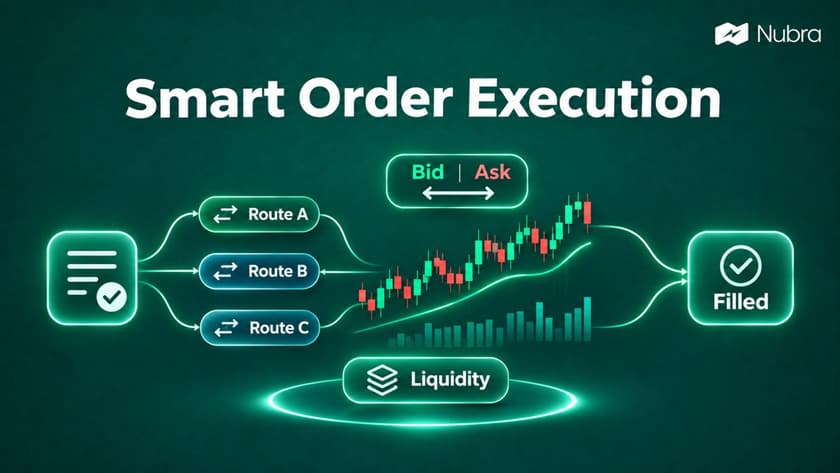
A trading idea becomes a position only when our order meets a matching order in the market. Between deciding to trade and receiving a fill, prices and available quantities can change. Advanced order execution means adding rules about when an order becomes active, how much can trade and how execution is spread out. These rules…
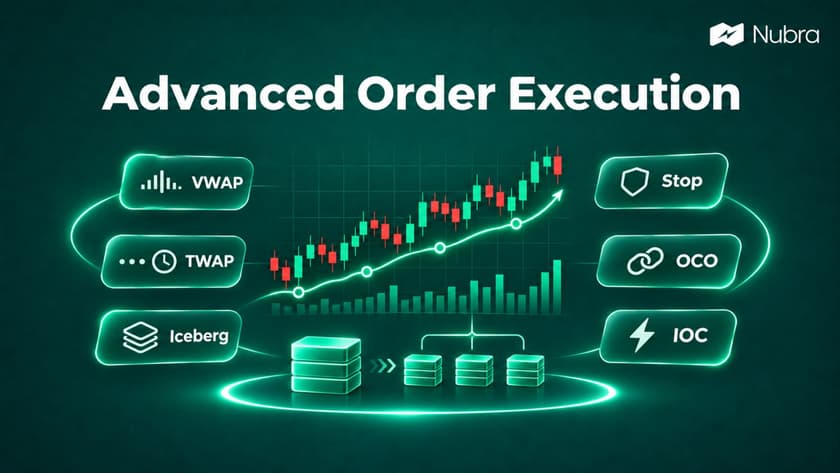
A trading idea becomes a position only when our order meets a matching order in the market. Between deciding to trade and receiving a fill, prices and available quantities can change.
Advanced order execution means adding rules about when an order becomes active, how much can trade and how execution is spread out. These rules help us express a plan more precisely. They cannot guarantee a fill, a particular price or a profitable result.
We can understand the choices by separating four questions: what price will we accept, when should the order activate, how long should it remain active, and how should we divide the quantity?
Start With Price Control and Fill Risk
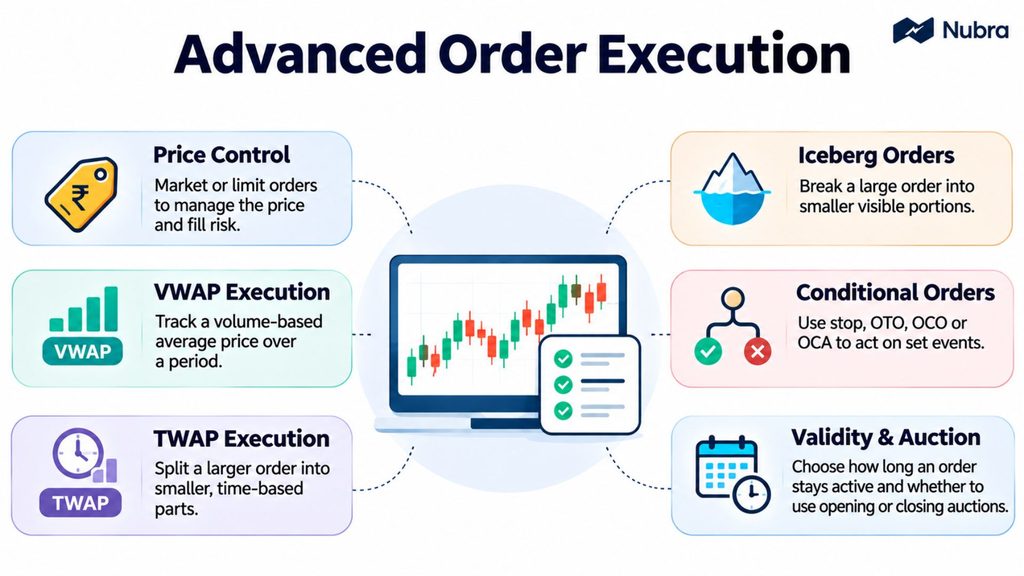
A market order seeks execution at available prices. A limit order sets our maximum buying price or minimum selling price. The trade-off is straightforward: a market instruction leaves the execution price uncertain, while a limit instruction may leave the trade incomplete.
Suppose we want 200 shares with a buying limit of ₹500. If only 80 shares are available within that limit, we may receive a partial fill while the balance waits, depending on validity. The last traded price of ₹500 does not establish that 200 shares are available there.
Before adding more conditions, we check available quantities and the bid–ask spread: the gap between the highest buying quote and lowest selling quote. Our guide to fast trade execution explains why speed and execution quality need to be considered together.
VWAP: Execution Against a Volume Benchmark
Volume-weighted average price, or VWAP, weights traded prices by their corresponding volumes over a defined period. A VWAP execution algorithm aims to trade in a way that tracks that benchmark, usually by distributing smaller orders across the chosen window.
We distinguish this from simply placing an order near a VWAP line on a chart. The indicator supplies context; the execution algorithm manages order submissions according to its rules.
A volume-based schedule can be useful when evaluating how to distribute a larger order. However, unexpected changes in volume or price can affect the result. Achieving the benchmark is an objective, not a promise, and restrictions on participation or price may leave quantity unfilled.
We also need a consistent comparison period. A fill measured against the whole day’s VWAP answers a different question from one measured against VWAP during our actual execution window.
TWAP: Spreading Orders Across Time
Time-weighted average price, or TWAP, averages prices across time, giving equal-length periods equal weight. A simple TWAP schedule divides a larger instruction into smaller portions submitted at regular intervals.
For illustration, we could divide a hypothetical 1,000-share instruction into ten 100-share portions across a chosen window. That describes the submission schedule; it does not mean every portion will fill immediately or at the same price.
The benefit is a defined pace. The limitation is that market liquidity does not arrive evenly. A fixed schedule may encounter a thin order book in one interval and more depth in another. Price limits and the end-time rule also affect whether the full quantity completes.
Neither VWAP nor TWAP removes market risk. We need to confirm whether the broker supports the relevant algorithm for the instrument and account before planning around it.
Iceberg Orders: Dividing the Visible Quantity
An iceberg order breaks a larger instruction into smaller visible portions. This differs from a TWAP schedule: the focus is the quantity displayed or released, rather than equal time intervals.
For example, a 2,000-share instruction might use 200-share portions. We still need to understand how each portion is released, priced and cancelled. Splitting an order does not create buyers or sellers, conceal every trace of trading activity or guarantee lower market impact.
Nubra’s order-placement guide documents iceberg orders. We should check current instrument eligibility and execution settings rather than assume every order type is available everywhere.
Stop and Conditional Orders: Defining What Happens Next
Conditional instructions connect an action to an event. We need to identify both the trigger and the order that follows it.
Stop-Market and Stop-Limit Orders
A stop-market order becomes a market order when its trigger condition is met. A stop-limit order becomes a limit order. Triggering and filling are separate events.
Consider a hypothetical sell stop-limit with a ₹490 trigger and ₹488 limit. If the market gaps to ₹480, the order may activate but remain unfilled because selling below ₹488 is outside its limit. A stop-market instruction could instead execute below the trigger, subject to availability and applicable rules.
We therefore cannot treat the trigger as a guaranteed exit price. Availability also varies by market segment and broker.
OTO, OCO and OCA Instructions
One-triggers-the-other (OTO) links a primary order to a follow-up order, commonly activating the second after the first fills.
One-cancels-the-other (OCO) links two orders so that an execution event in one causes cancellation of the other. One-cancels-all (OCA) extends that relationship to a group.
The detail matters: platforms can handle partial fills and cancellation events differently. Two separately entered exit orders do not become an OCO pair merely because we intend them to work together. Cancellation requests also need confirmation.
These are general execution concepts, not a statement that Nubra supports every configuration. Our automated trading platforms guide explores why predefined rules still need monitoring.
Validity and Auction Instructions Need Separate Checks
Validity determines how long an order remains active. A DAY order normally expires at the end of the trading day if unmatched. An immediate-or-cancel (IOC) instruction attempts an immediate match and cancels the remainder; partial execution is possible.
Fill-or-kill (FOK), where supported, requires immediate execution of the entire quantity or cancellation. It is different from IOC, which can leave us holding a smaller position.
Market-on-open and market-on-close instructions, where available, target opening or closing auction execution. They do not let us choose the auction price. We need to check the relevant exchange session, eligible instruments and broker cut-offs. An order submitted before the session is not automatically an opening-auction instruction.
We should avoid carrying labels or timings from overseas order guides directly into Indian trading. Broker functionality and exchange rules determine what we can actually submit.
How We Prepare and Review an Execution Plan
Before submission, we confirm the instrument, expiry, quantity, direction, price instruction, trigger and validity. For options, we also check lot requirements and the relationship between legs.
A multi-leg strategy can become a different position if only some legs fill. We need a defined response to incomplete execution rather than assume submitting a basket makes every leg complete together.
We can use the Nubra Option Chain to examine contract prices, volume, open interest and Greeks. Open interest describes outstanding contracts; it does not establish the quantity available at our intended price.
The Nubra Strategy Builder helps us construct multi-leg options positions and examine payoff scenarios. Nubra Charts provide price context. Access may require sign-in. These tools support analysis; modelled payoffs and chart levels do not guarantee execution outcomes.
After submission, we compare acknowledged, filled, pending and cancelled quantities with our actual position. If a request times out, we check its status before resubmitting: a missing response does not prove the first instruction failed.
Our algorithmic trading with Python guide covers the wider testing process. For execution review, we record a consistent reference price, average fill price, filled quantity, completion time and charges. That helps us examine what happened without confusing a well-handled order with a profitable trading idea.
FAQs
What Is Advanced Order Execution?
It is the use of additional rules to control order activation, timing, quantity or linked actions. We still depend on available liquidity, broker functionality and exchange rules.
How Do VWAP and TWAP Differ?
VWAP uses traded volume to weight its price benchmark. TWAP focuses on time. Their execution schedules pursue different objectives, and neither guarantees completion or benchmark performance.
Does a Stop-Loss Guarantee Our Maximum Loss?
No. A stop-market order can fill beyond its trigger, while a stop-limit order may remain unfilled. Gaps, liquidity and execution conditions can make actual losses larger than planned.
Can an IOC Order Be Partially Filled?
Yes. The immediately available quantity can trade, while the unmatched balance is cancelled. We need to review the actual filled quantity before deciding what happens next.
Does Submitting a Basket Guarantee That All Legs Fill?
No. We need to verify the platform’s execution mechanism and monitor individual legs. Partial or rejected execution can leave a position different from the one we planned.
Can We Use Every Advanced Order Type on Nubra?
We should verify each instruction against current Nubra documentation and account functionality. This guide explains general concepts; availability depends on the product, instrument and applicable rules.
Disclaimer: The information provided in this blog is for educational and informational purposes only and should not be construed as investment advice, financial advice, or a recommendation to buy, sell, or hold any securities or financial products. Investments in the securities market are subject to market risks. Please read all related documents carefully before investing. Readers should conduct their own research and consult a SEBI-registered investment adviser or other qualified financial professional before making any investment decisions. Past performance is not indicative of future results.