Choosing algo trading software starts with a practical question: what do we need the software to do? Building rules, testing an options strategy and sending live orders are different jobs. A platform may handle one well without covering the others. Our first recommendation is Nubra for Indian traders who want options analysis, strategy planning and…
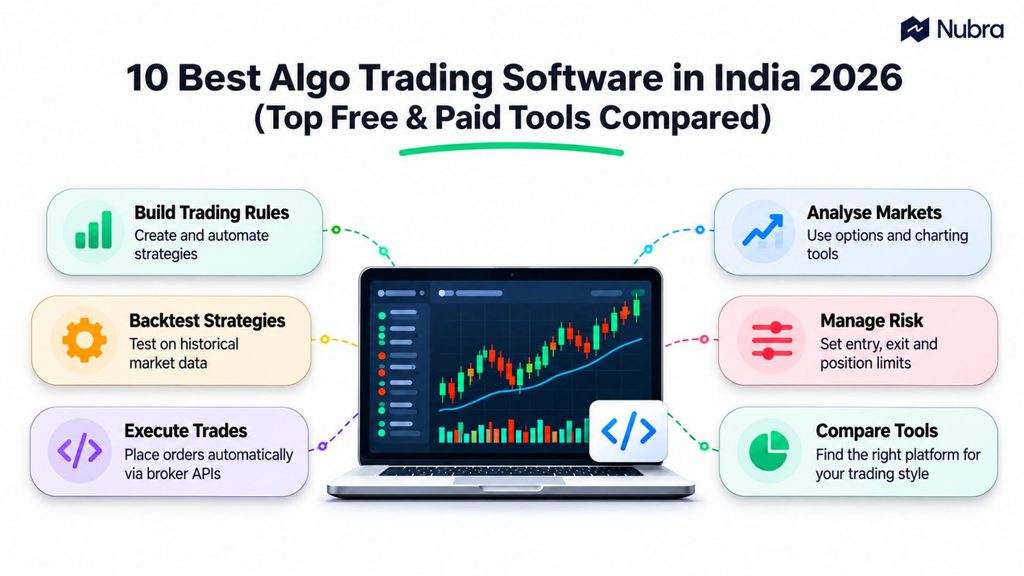
Choosing algo trading software starts with a practical question: what do we need the software to do? Building rules, testing an options strategy and sending live orders are different jobs. A platform may handle one well without covering the others.
Our first recommendation is Nubra for Indian traders who want options analysis, strategy planning and execution tools in one platform. We then compare nine alternatives for more specific requirements, including historical testing, no-code rules and custom development.
This guide is published by Nubra. We lead with the strengths of our platform and compare tools by use case; placement does not imply superior returns or suitability for every trader.
Algo Trading Software in India: Quick Comparison
We have compared published product information and pricing available on 25 October 2026. This is a desk-researched comparison, rather than a claim that we have traded through every platform. Broker compatibility, plan limits and charges can change.
| Software | Main use | Coding requirement | Pricing approach and key limitation |
| Nubra | Options analysis, strategy planning and execution tools | Visual tools; coding for custom API systems | Integrated trading tools, Flexi Orders and API routes; check current Nubra pricing and integration terms |
| AlgoTest | Options backtesting and deployment | No-code builder | 25 backtests a week at ₹0; paid credits from ₹499 for 500 credits |
| Tradetron | Rule-based strategies across supported brokers | No-code builder | ₹0 Live Offline; Starter ₹3,000 billed annually, equivalent to ₹250/month |
| Streak | Indicator rules, backtesting and alerts | No-code builder | ₹0 platform subscription for Zerodha users; trading charges remain |
| FYERS Automate | Broker-native visual automation | No-code canvas | Standard and Prime usage limits differ; Prime ₹499/month excluding GST |
| Quantiply | Options execution rules and adjustments | No-code configuration | Starter ₹250/month; one algo run per day |
| AlgoBulls | Ready-made and custom strategy routes | Depends on product | Phoenix and Odyssey plans; confirm the current tariff |
| uTrade Algos | Strategy building, testing and deployment | No-code tools | Beginner ₹99/month plus GST; credit and deployment limits apply |
| Algomojo | Connecting signals to broker execution | Depends on signal source | Broker-linked access and charges; confirm the complete setup cost |
| Zerodha Kite Connect | Building custom trading applications | Programming required | Personal API at ₹0 subscription; Connect data suite ₹500/month |
These figures describe software access, not the full cost of trading. Brokerage, taxes, market data, hosting and third-party services may be additional. A ₹0 testing allowance does not necessarily include live automation.
1. Nubra: Our First Pick for Integrated Options Trading
For traders who want to analyse, plan and execute in one platform, Nubra is our first recommendation. The advantage is the combination of options tools and execution features, with API and integration routes for more customised needs.
We can examine strikes with Nubra Option Chain, explore multi-leg structures in Nubra Strategy Builder, and study price action through Nubra Charts. Nubra also supports chart-led execution and Flexi Orders, where entry, exit and trigger conditions can be defined in advance.
For systematic trading, our API documentation covers developer access, while the documented Tradetron integration provides a route to broker-connected strategies. These are distinct choices: analysis tools, conditional orders and a custom algo system serve different needs.
Why start here? We can assess the trading tools first, then choose an automation route that matches our rules. Confirm current Nubra pricing, account eligibility and integration requirements. Historical testing or custom deployment may require additional software and setup.
2. AlgoTest: For Options Backtesting
AlgoTest brings options strategy building, historical testing, forward testing and broker-connected execution into one platform. It suits traders who want to turn entry times, strike selection and exit rules into a testable strategy without writing code.
Its pricing uses credits. The ₹499 starter pack contains 500 credits; that is a credit purchase, rather than a standard monthly subscription. Different features consume credits differently.
We would check the cost of the intended testing and deployment schedule before comparing it with a subscription. For multi-leg options, we also need realistic assumptions about slippage: a modelled exit price may differ from the price available in a moving market.
3. Tradetron: For Flexible Rule Building
Tradetron offers a no-code strategy builder, broker connections and a strategy marketplace. Its appeal lies in combining conditions into a repeatable process rather than entering each instruction manually.
Live Offline runs strategy logic without sending broker orders. General paid plans add live deployment capacity, while certain broker-linked arrangements have different terms. The Starter price shown on annual billing is ₹3,000 a year, equivalent to ₹250 a month.
We should examine the strategy rules and deployment limits as closely as the subscription. A marketplace listing or historical performance chart does not establish that a strategy will suit our capital or tolerate future market conditions.
4. Streak: For Indicator-Based Strategy Research
Streak lets us create indicator-based rules, run backtests and use scanners and strategy alerts without programming. Its official help material states that the platform has no subscription charge for Zerodha users; brokerage and transaction charges still apply.
This makes it a relevant starting point when our strategy can be expressed through its supported conditions.
Before relying on it for execution, we need to confirm the current order-placement process. An alert, an order confirmation and unattended automation are different capabilities. We should also check whether the selected instruments and strategy type support the testing and deployment process we need.
5. FYERS Automate: For Broker-Native Workflows
FYERS Automate uses a visual canvas to connect triggers, conditions and actions. Its FIA assistant can also translate a plain-English strategy description into a workflow for review.
We still need to inspect the generated quantities, conditions and exits. Creating a workflow does not deploy it; deployment is a separate action, and a deployed workflow can place live orders.
FYERS Prime costs ₹499 a month excluding GST and expands selected usage limits. We should compare the current Standard and Prime allowances against our intended usage rather than assume a paid plan is required for every task. The platform is tied to the FYERS account environment.
6. Quantiply: For Options Execution Rules
Quantiply focuses on configurable options trading logic, including strike selection, stop-loss handling and re-entry settings. It is worth examining when the details of how an options strategy enters and adjusts matter more than a broad indicator library.
The published Starter plan costs ₹250 a month and allows one algo run per day. Other plans and broker-linked arrangements have different allowances.
We need to understand what counts as a run before choosing a plan. Re-entry rules also deserve attention: repeatedly reopening a position can change turnover, transaction costs and total exposure, even when each individual entry follows the original logic.
7. AlgoBulls: For Different Levels of Strategy Customisation
AlgoBulls offers Phoenix and Odyssey product routes covering strategy creation and automation. It is a platform to assess when we want to compare packaged tools with more customised strategy development.
The useful comparison is at product and plan level. We should establish which route includes the required strategy controls, testing facilities, broker support and deployment arrangements.
Its public pricing page directs readers towards product-specific plans, so we have not assigned an unverified starting price. Requesting a complete tariff helps us separate software access, support and any additional services. AI-assisted development still needs the same rule checks and testing as manually written logic.
8. uTrade Algos: For No-Code Building and Testing
uTrade Algos combines strategy-building tools with backtesting, forward testing and deployment features. Its range includes no-code and AI-assisted tools, alongside ready-made strategy offerings.
The published Beginner plan is ₹99 a month plus GST, with 75 monthly credits and two concurrent live deployments. These limits matter as much as the headline price.
We should estimate how much testing our development process will consume before subscribing. Two concurrent deployments describe capacity, rather than the number of strategies that will perform well. Generated or pre-built rules still require review for position sizing, exits and behaviour during unusual market moves.
9. Algomojo: For Connecting Signals to Execution
Algomojo provides an execution layer for signals generated through supported charting or analysis setups. It is relevant when we already have strategy logic and need to assess how it can connect to a broker.
The complete system may involve several components: the signal source, the connection service and the trading account. Pricing and access depend on the broker arrangement and chosen setup.
We would test the full chain, including rejected orders, duplicate signals and connection failures. A correctly generated signal is only one part of a completed trade. Check which component records the order status and how an open position can be managed if the signal connection stops.
10. Zerodha Kite Connect: For Developer-Built Systems
Kite Connect provides APIs for developers building trading applications. Zerodha lists a Personal route without a subscription charge for order and account functions, while the Connect suite with streaming and historical market data costs ₹500 a month.
This route gives us control over application logic, but we must build and maintain that logic ourselves. It is not a ready-made strategy builder.
Our budget should include data, hosting and development time where needed. We also need handling for authentication, order rejections and reconciliation between our application and broker positions. Readers exploring this distinction can start with Nubra’s guide to API trading.
How We Would Choose Between These Tools
We would start with the strategy requirements rather than the longest feature list. No-code tools suit rules that fit their supported conditions. Developer APIs suit custom requirements when we can maintain the software. Research applications need a separate assessment of live execution.
Next, we would test the same rules across different market periods, account for charges and slippage, and avoid repeatedly adjusting parameters just to improve historical results. Our quantitative trading guide explains the relationship between data, rules and validation.
Before live use, confirm the broker’s current API and retail algo onboarding requirements. India’s retail algo framework applies from 1 April 2026; the applicable operational checks depend on the setup. A software subscription does not establish regulatory approval for every strategy.
Why We Would Start With Nubra
For active options traders, our starting point is the combination of Option Chain, Strategy Builder and Charts introduced above. It gives us a clear way to move from examining the market to defining a trade before deciding how much automation the strategy needs.
A dedicated backtester or developer toolkit can still be useful for specialist requirements. Nubra belongs first on this shortlist when the priority is bringing trading analysis and execution tools together, with documented API and integration routes to explore as requirements develop. Some tools require sign-in; verify availability and charges before use.
For a closer look at turning trading rules into a repeatable process, read our guide to algorithmic and automated intraday trading. The aim is to understand the rules and their limitations before choosing how to execute them.
FAQs
How Do We Choose Algo Trading Software in India?
We would start with Nubra when we need options analysis, strategy planning and execution tools together. For specialist testing or custom development, compare the alternatives against our strategy, broker and technical requirements. No single tool suits every trader.
Can We Start Without a Software Subscription?
Some tools offer ₹0 testing or account-linked access. These allowances may exclude live execution, market data or other services. Brokerage and transaction charges can still apply.
Do We Need Coding Skills for Algo Trading?
No-code builders support predefined conditions without programming. Custom API systems require coding skills or technical support. Either route requires clear trading rules.
Is Backtesting the Same as Paper Trading?
No. Backtesting applies rules to historical data. Paper or forward testing observes simulated behaviour as new data arrives. Neither reproduces every live fill, rejection or liquidity constraint.
Can Algo Software Guarantee Profits?
No. Automation follows instructions; it cannot remove market risk. Historical results, simulated results and marketplace performance do not guarantee future returns.
What Should We Check Before Enabling Live Orders?
Check broker compatibility, onboarding requirements, costs, quantities, exits, position limits and order-status monitoring. We also need a way to stop the system and manage positions if a connection fails.
Disclaimer: The information provided in this blog is for educational and informational purposes only and should not be construed as investment advice, financial advice, or a recommendation to buy, sell, or hold any securities or financial products. Investments in the securities market are subject to market risks. Please read all related documents carefully before investing. Readers should conduct their own research and consult a SEBI-registered investment adviser or other qualified financial professional before making any investment decisions. Past performance is not indicative of future results.